Crypto Refunds 2026: How Merchants Send Money Back
Crypto refunds are new payments, not reversals. Compare refund tools, fees and rate policy across seven gateways, with network costs priced for 2026.
Key Takeaways
- A refund is a new payment, so half the gateways do not have one. The refund button only exists where the gateway holds a balance. NOWPayments tells you to send it from your own wallet; Plisio publishes no refund status at all, only an over/underpayment notice with the customer's email attached.
- The rail costs far more than the gateway does. Priced on 10 September 2026, refunding USDT over TRC-20 cost $2.20-$4.41 against 4.7 cents for the same refund on Ethereum — a 47x to 94x gap on the chain most merchants were told was the cheap one.
- Everyone now refunds the value, not the coins. CoinGate converts at the current rate, Crypto.com Pay guarantees the original pricing value, and BitPay marked its fixed-rate refund type deprecated. The customer carries the price move, and no gateway says so out loud.
- Who pays the fee is a parameter, not a policy. BitPay's
buyerPaysRefundFeedefaults to false and Cryptomus'sis_subtractdecides whether the commission leaves your balance or the customer's refund. Both default to you paying unless you change them. - Refunds expire. BitPay's refund email link expires in 3 days and an unprocessable refund after 10 days. Cryptomus blocks payouts, and therefore refunds, for 24 hours after a password change.
Table of Contents
- A refund is a new payment, and that changes everything
- Does your gateway even have a refund tool?
- What crypto refunds cost on the wire
- The gateway's fee, and who actually pays it
- Refund the coins or refund the value?
- The refund address is where the money gets lost
- The deadlines nobody puts on a pricing page
- Writing a refund policy that survives a real customer
- FAQ
A refund is a new payment, and that changes everything
A customer pays you 0.0013 BTC for a jacket, the jacket does not fit, and now you owe them their money back. On a card you would press refund and the network would unwind the authorisation for you. On-chain there is nothing to unwind, and that is the point — the irreversibility you accepted crypto for is the same property that makes crypto refunds a job rather than a button. We read the published refund documentation of seven gateways for this piece and priced the on-chain leg against live network data, because the cost of getting this wrong is a customer who is out of pocket and a support thread you cannot close.
CoinGate says it as plainly as anyone in its own merchant refunds documentation: a refund "is not a reversal. It is a new payment you send back to the customer, with you choosing the amount and currency." Three consequences fall straight out of that sentence, and most merchants meet them one at a time, in production.
What "new payment" actually means for you
- You need a destination. The chain does not remember who the customer is, only which address the coins came from — and that address is often not theirs.
- You pay to send it. A refund carries a network fee like any other transaction, and on some rails that fee is larger than the margin on the order.
- You have to pick a number. The coin has moved since the sale, so refunding "the same amount" means two different things depending on which amount you mean.
None of that is exotic. It is just that the refund flow is the part of a gateway nobody demos, so it stays invisible until the first return lands. This is the same failure pattern we found on the receiving side in our guide to crypto payments that never arrive: the documented happy path is fine, and the exception path is where the money sits.
Does your gateway even have a refund tool?
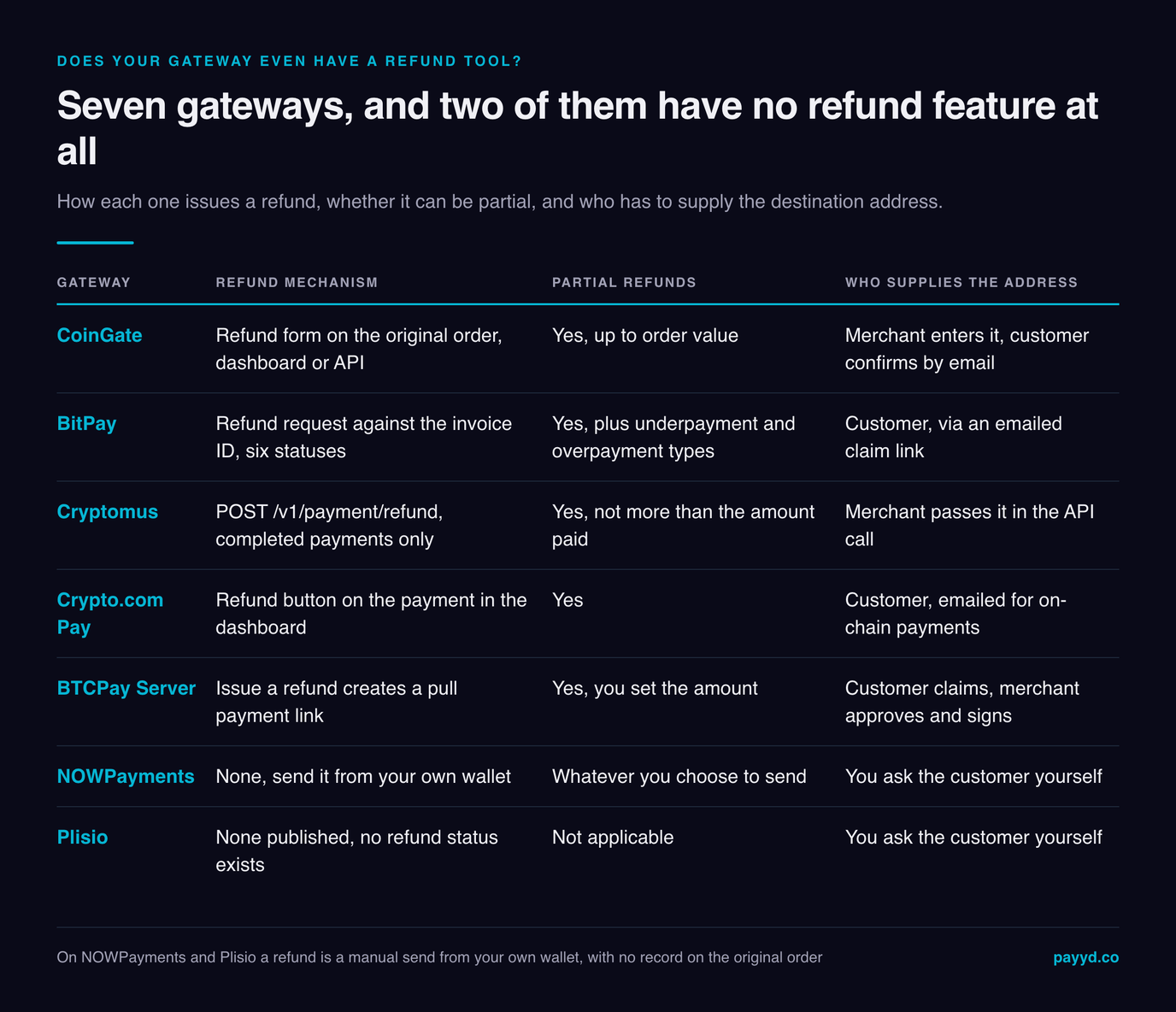
Start here, because the answer is not always yes and it follows a rule that nobody states: a refund tool can only exist where the gateway holds a balance for you. If the gateway never touches your money, there is nothing for it to send back, and the refund is your job with your own wallet. That single fact splits the market cleanly in two.
NOWPayments is the clearest case. Its published refund policy states that because it is a non-custodial service, "we do not store your funds and have no control over them", and instructs merchants to "simply send your customer the required amount of money from your crypto wallet", looking the exact sum up by Payment ID. It will step in for deposits that went wrong at the customer's end — wrong asset, wrong network, a missing memo, a payment below the minimum — but a change of mind is not that. Plisio goes further and publishes no refund status whatsoever: its transaction status documentation lists New, Pending, Completed, Underpaid, Cancelled/Expired and Error, and handles overpayment by giving you "the client's actual order and e-mail address in case the seller will have to contact the client to compensate overpayment".
| Gateway | Refund mechanism | Partial refunds | Who supplies the address |
|---|---|---|---|
| CoinGate | Refund form on the original order, dashboard or API | Yes, up to order value | Merchant enters it, customer confirms by email |
| BitPay | Refund request against the invoice ID, six statuses | Yes, plus underpayment and overpayment types | Customer, via an emailed claim link |
| Cryptomus | POST /v1/payment/refund, completed payments only | Yes, not more than the amount paid | Merchant passes it in the API call |
| Crypto.com Pay | Refund button on the payment in the dashboard | Yes | Customer, emailed for on-chain payments |
| BTCPay Server | "Issue a refund" creates a pull payment link | Yes, you set the amount | Customer claims, merchant approves and signs |
| NOWPayments | None — send it from your own wallet | Whatever you choose to send | You ask the customer yourself |
| Plisio | None published — no refund status exists | Not applicable | You ask the customer yourself |
BTCPay Server sits in an interesting middle. It is self-hosted and nobody holds your keys, yet it does ship a refund flow — built, as its documentation notes, "on top of the Pull Payments feature". You issue a refund against the invoice, share a link, the customer supplies an address and claims it, then you approve and sign. The docs are explicit that "BTCPay Server does not approve and pay a payout automatically", so a refund on BTCPay always costs you a manual step. If the trade-off between these architectures is new to you, our explainer on custodial versus non-custodial gateways covers the same split on the receiving side.
What crypto refunds cost on the wire
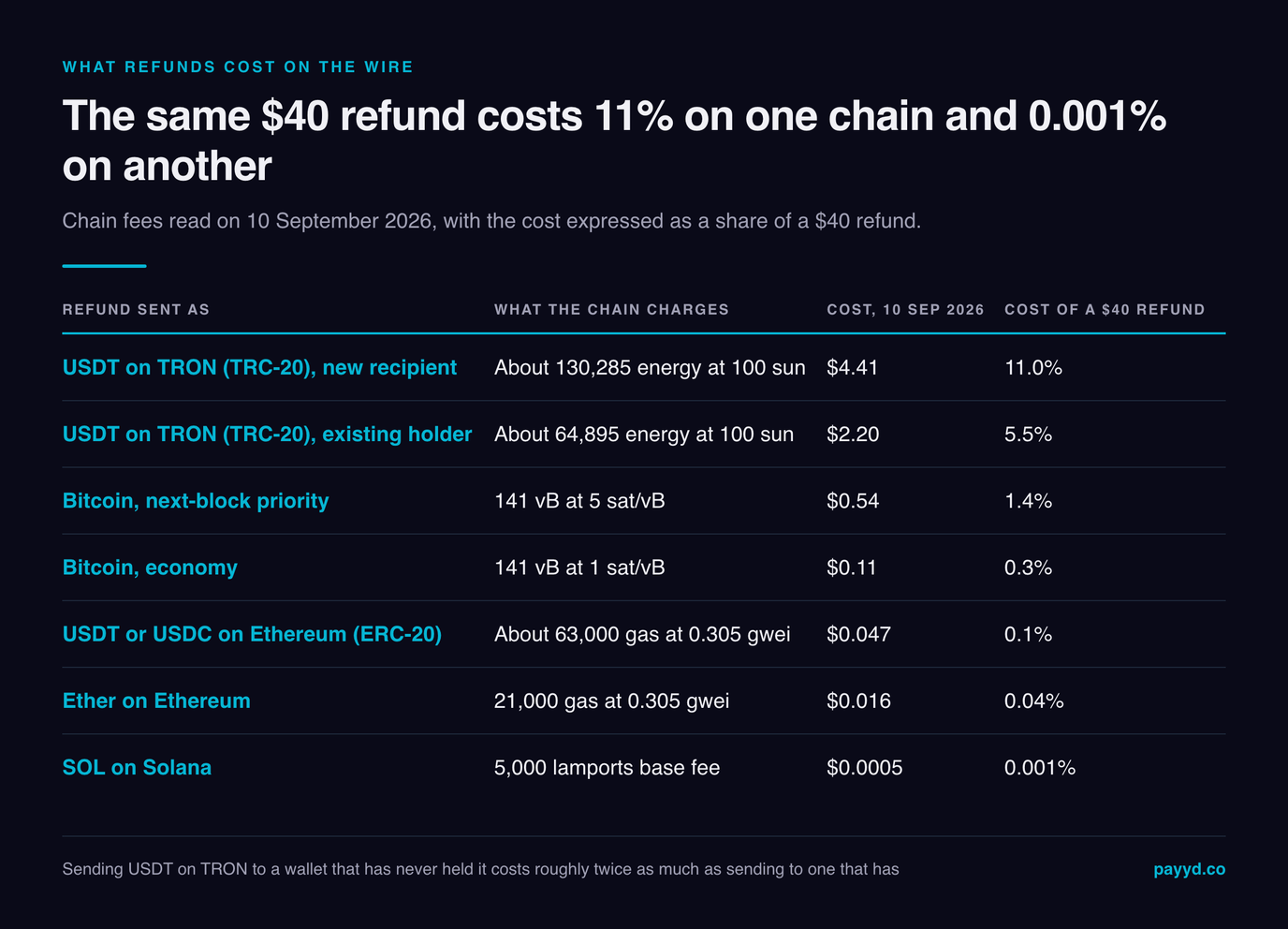
This is where the money quietly goes, and it is the section every competing article on this topic skips. A refund is an outbound transaction, so it pays whatever the chain charges that day. We priced each rail against live network data on 10 September 2026: Bitcoin fee estimates from mempool.space, Ethereum's base fee read from block 25,947,632 at 0.305 gwei, TRON's getEnergyFee chain parameter at 100 sun, and spot prices of $77,289 BTC, $2,440.68 ETH, $0.3387 TRX and $100.17 SOL.
| Refund sent as | What the chain charges | Cost, 10 Sep 2026 | Cost of a $40 refund |
|---|---|---|---|
| USDT on TRON (TRC-20), new recipient | ~130,285 energy at 100 sun | $4.41 | 11.0% |
| USDT on TRON (TRC-20), existing holder | ~64,895 energy at 100 sun | $2.20 | 5.5% |
| Bitcoin, next-block priority | 141 vB at 5 sat/vB | $0.54 | 1.4% |
| Bitcoin, economy | 141 vB at 1 sat/vB | $0.11 | 0.3% |
| USDT or USDC on Ethereum (ERC-20) | ~63,000 gas at 0.305 gwei | $0.047 | 0.1% |
| Ether on Ethereum | 21,000 gas at 0.305 gwei | $0.016 | 0.04% |
| SOL on Solana | 5,000 lamports base fee | $0.0005 | 0.001% |
Read the top two rows against the fifth, because that comparison is the finding. Refunding a stablecoin over TRC-20 cost between 47 and 94 times what the same refund cost on Ethereum on the day we measured. TRON's energy price is fixed by a chain parameter rather than an auction, so it does not fall when the network is quiet, while Ethereum's base fee at 0.305 gwei is a fraction of what it was in the years when "use TRON, it's cheaper" became received wisdom. If your refund volume is meaningful and your customers hold USDT, the chain you default to is worth re-checking rather than inheriting — our USDT acceptance guide goes through the same choice on the inbound leg.
One caveat we will not paper over: the two TRON energy figures are the well-known typical consumption of a TRC-20 transfer to an address that already holds the token and to one that does not. The 100 sun energy price is read from the chain today; the energy quantity is a standard figure rather than one we measured, so treat those two rows as a close estimate and the direction of the gap as the point. Note also that a merchant refunding an ERC-20 token from a self-custody wallet needs the network token to pay gas — Coinbase Commerce's help centre spells this out for its own self-custody flow, warning that refunding USDC on Ethereum requires a sufficient ETH balance. An empty gas tank stops a refund as effectively as an empty balance.
The gateway's fee, and who actually pays it
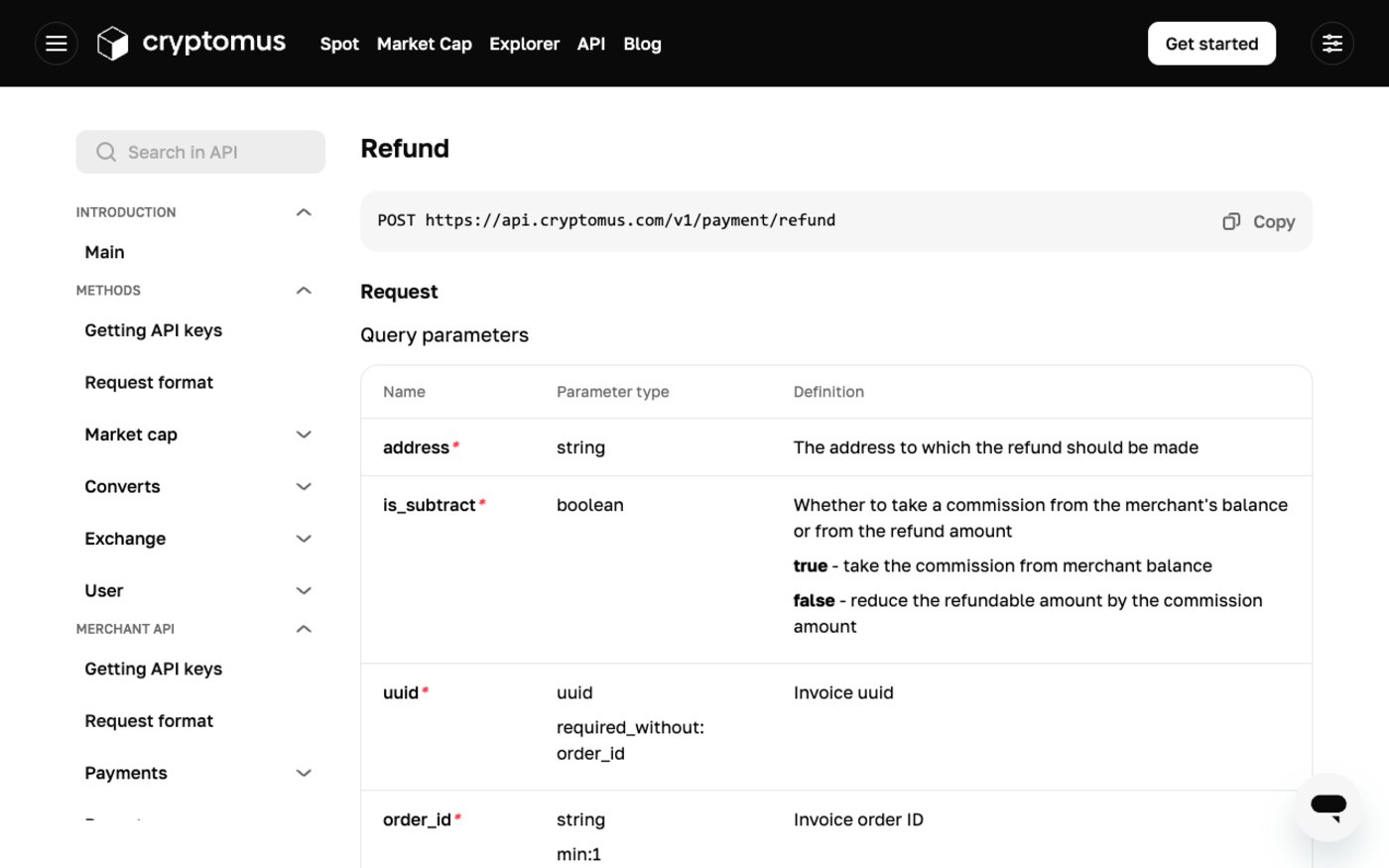
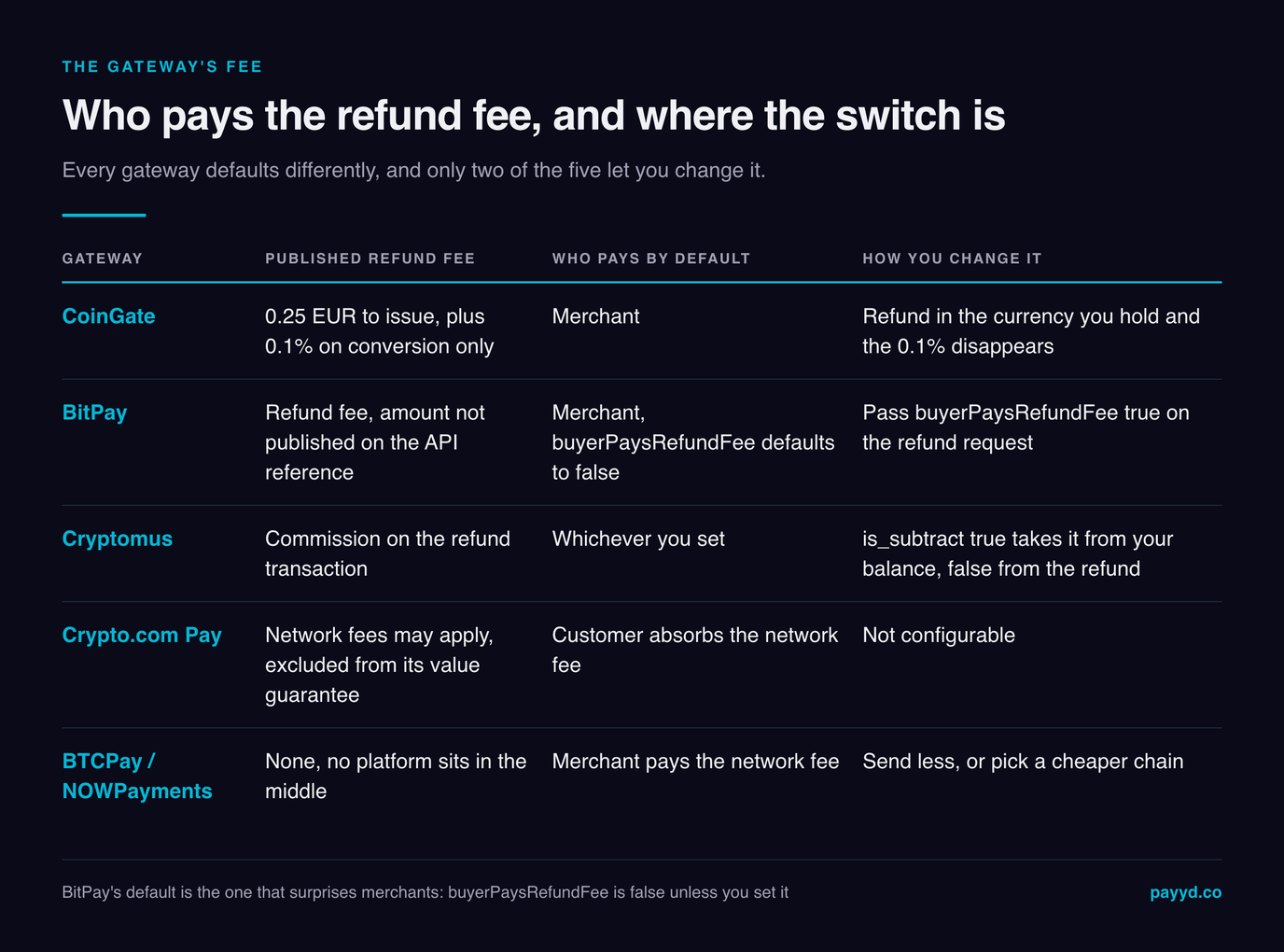
On top of the chain, the gateway takes its own cut for issuing the refund — and the more interesting question is whose pocket it comes out of, because on two of the major gateways that is a parameter with a default you probably have not looked at.
| Gateway | Published refund fee | Who pays by default | How you change it |
|---|---|---|---|
| CoinGate | 0.25 EUR to issue, plus 0.1% on conversion only | Merchant | Refund in the currency you hold and the 0.1% disappears |
| BitPay | Refund fee, amount not published on the API reference | Merchant — buyerPaysRefundFee defaults to false | Pass buyerPaysRefundFee: true on the refund request |
| Cryptomus | Commission on the refund transaction | Whichever you set | is_subtract: true takes it from your balance, false from the refund |
| Crypto.com Pay | Network fees may apply, excluded from its value guarantee | Customer absorbs the network fee | Not configurable |
| BTCPay / NOWPayments | None — no platform sits in the middle | Merchant pays the network fee | Send less, or pick a cheaper chain |
CoinGate's structure is the one worth studying because it is fully published: 0.25 EUR per refund plus 0.1% that applies only when a conversion happens, and, in its own words, "refund in the same currency you hold, and there is no conversion fee at all." Run that against order size and the flat component dominates at the bottom of the range — 0.26 EUR on a 12 EUR refund is 2.2% of the order, while 1.25 EUR on a 1,000 EUR refund is 0.13%. Low-ticket sellers processing returns are paying a percentage that would look alarming on a card statement, and it is invisible until you total it. That flat-fee-versus-percentage dynamic is the same one we mapped across the whole market in our gateway fee comparison.
Refund the coins or refund the value?
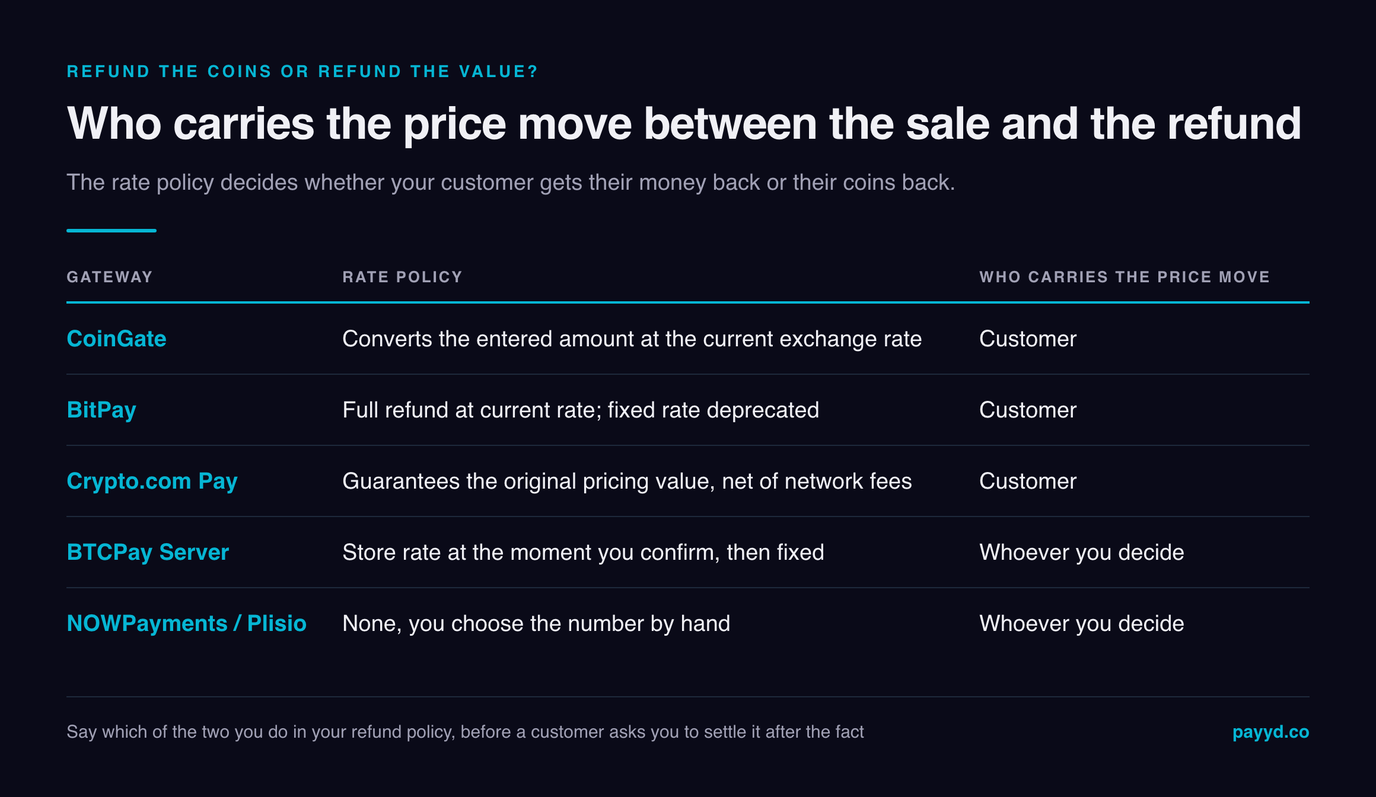
Here is the question that generates the arguments. A customer paid 0.0013 BTC for a $100 jacket. By the time they return it, bitcoin has moved 20%. Do you send back 0.0013 BTC, or $100 worth of BTC at today's price? Those are different numbers, and someone is worse off either way.
What surprised us is how completely the industry has converged, and how quietly. Every gateway we checked refunds the fiat value at the current rate, not the original quantity of coins. CoinGate states that "the entered amount will be converted to a cryptocurrency a customer wants to get back using its current exchange rate". Crypto.com Pay "guarantees the refund cryptocurrency amount to be the same value as the original pricing value (excluding blockchain network fees, if applicable)". BitPay's refund reference lists a full refund "at current rate" as the live option and marks its fixed-rate refund type deprecated — a design decision, not an omission. BTCPay, characteristically, hands you the choice and then warns in its pull payments documentation that once you confirm a payout "the rate is then fixed, even if you don't complete the payment".
| Gateway | Rate policy | Who carries the price move |
|---|---|---|
| CoinGate | Converts the entered amount at the current exchange rate | Customer |
| BitPay | Full refund at current rate; fixed rate deprecated | Customer |
| Crypto.com Pay | Guarantees the original pricing value, net of network fees | Customer |
| BTCPay Server | Store rate at the moment you confirm, then fixed | Whoever you decide |
| NOWPayments / Plisio | None — you choose the number by hand | Whoever you decide |
The convergence makes commercial sense — refunding the original coin quantity would let a customer buy at a low and return at a high, which is a free option written by your returns desk. But it does hand the customer a loss when the coin has fallen, and none of the four gateways says so in plain language. If you accept crypto and you refund at value, say it in your policy in one sentence so nobody discovers it during a return. The one genuinely clean escape is stablecoins: refund a USDC payment in USDC and the question never arises, which is a quiet argument for the stablecoin-first posture we describe in our stablecoin payments guide.
Refunds are simplest when nobody is holding your money
NOWPayments forwards each payment straight to your own wallet, so a refund is one transaction you send on the chain and the rate you choose — no platform fee, no claim link, no waiting on a balance. 0.5% on payments, 300+ coins, no KYC to start.
Get a NOWPayments API Key →The refund address is where the money gets lost
Of everything in this article, this is the one that costs real money, and it is a single instinct that causes it: sending the refund back to the address the payment came from. It looks like the obvious move. It is often wrong.
If the customer paid from an exchange account, the sending address belongs to the exchange, not to them. It is a hot wallet or a shared deposit address, and coins arriving there unannounced may never be credited to the person who bought your jacket. They cannot be recalled either. This is precisely why every gateway with a refund tool refuses to reuse the sending address and goes back to the customer instead — CoinGate takes wallet details on the form and then "sends a confirmation request to the customer" who "must also confirm the refund request via email"; BitPay emails a claim link and collects the address there; Crypto.com Pay says that for on-chain payments "we will email the customer to ask for a valid wallet address before proceeding".
Four checks before you press send
- Ask, never assume. Get the destination address from the customer in writing, even when the sending address is right there in the dashboard.
- Match the network, not just the ticker. USDT on TRON and USDT on Ethereum are different assets to a wallet. Refund on the chain they paid on unless they explicitly ask otherwise.
- Carry the memo or destination tag. On XRP, XLM and similar chains an exchange deposit without its tag is an unattributed payment and a support ticket at the far end.
- Send a test on anything large. A 5 cent test transfer on Ethereum is cheaper than any of the alternatives to being wrong.
Worth noting that these are the same failure modes NOWPayments will actually help unpick on the inbound side — wrong asset, wrong network, missing memo, below minimum — and it maintains an address whitelisting arrangement so merchants who refund often do not repeat a validation step every time. On the outbound side, though, nobody is checking your work. The chain does what you tell it.
The deadlines nobody puts on a pricing page
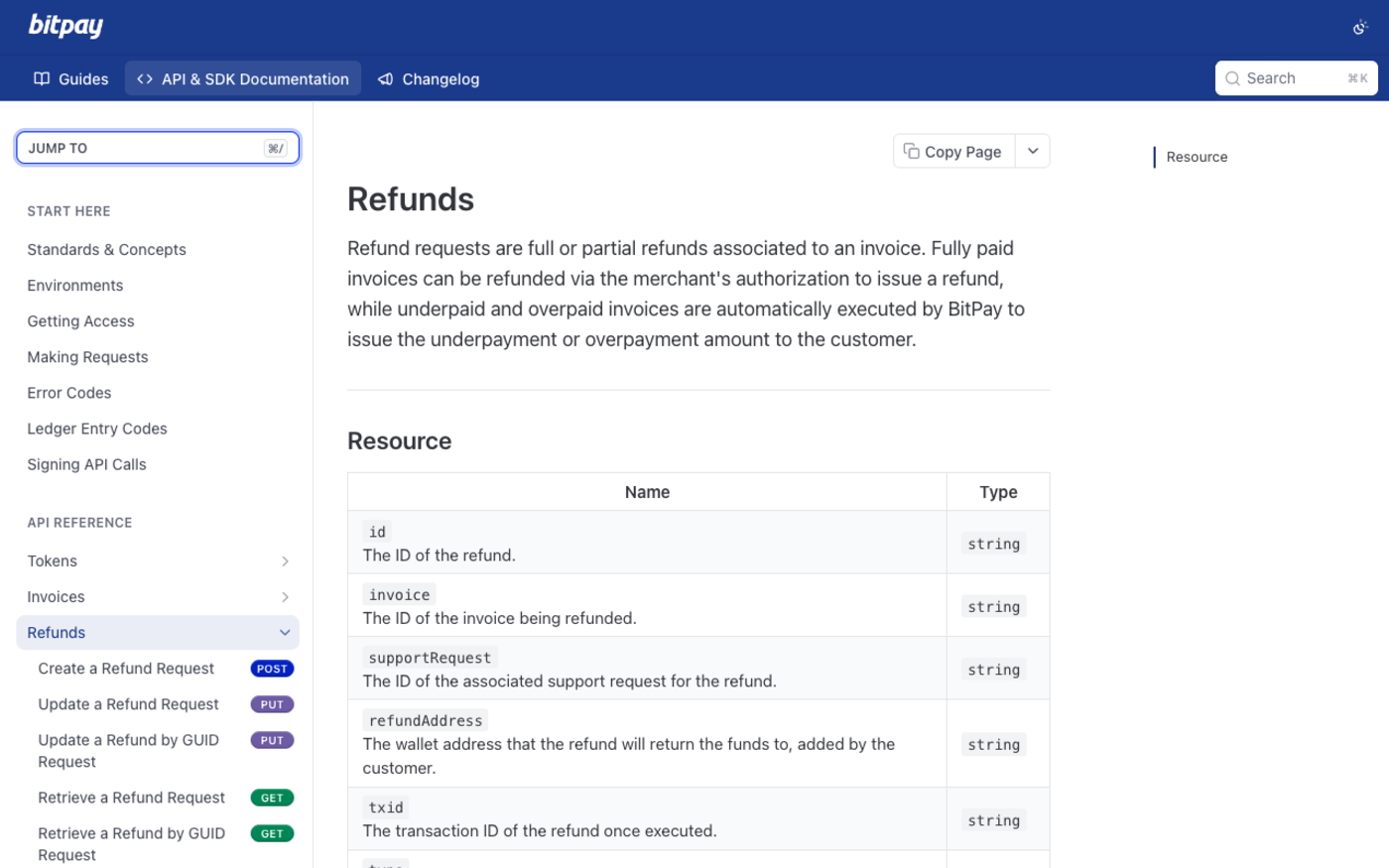
Refund flows expire, and the windows are short enough to matter. BitPay's support centre documents that a refund email link expires within three days, after which the customer must contact support through the BitBot to be issued a new one, and that a refund which cannot be processed — a merchant with an insufficient balance, for instance — expires after ten days. Once the address is in, BitPay says the refund should complete within one to two business days.
Cryptomus has a different and more surprising blocker. Its refund documentation requires that payouts are not blocked on your merchant account, and notes that a password change blocks payouts for 24 hours. Rotate a credential on a Friday afternoon and your refunds are frozen until Saturday, which is not a sentence anyone expects to read in a payments runbook. The rest of its conditions are sensible: refunds only for completed payments, no more than the amount paid, and the merchant wallet attached to the invoice still has to exist.
A note on sourcing, since this niche punishes sloppy figures. BitPay's support pages sit behind a bot challenge that returns a block page to automated fetchers, so the three-day and ten-day windows were read through search results on BitPay's own support domain rather than fetched directly, and everything else here comes from documentation we retrieved in full on 10 September 2026. Check the current page before you write either number into a customer-facing policy.
Writing a refund policy that survives a real customer
Most crypto refund policies are a card refund policy with the word "crypto" pasted in, which is why they fall apart on first contact. Four sentences fix it, and each one answers a question this article has raised.
- Which value. "Refunds are issued for the fiat price paid, converted to crypto at the exchange rate on the day of the refund." One line, no argument later.
- Which chain. "Refunds are sent on the network the payment was received on." Protects you from a customer asking for a cheap chain you do not hold.
- Who pays the fees. "Network and processing fees are deducted from the refund amount" — or absorbed by you, but say which.
- How long they have. "Refund requests are closed if we do not receive a destination address within X days." Gives your finance team a way to close the loop.
Then do the operational half, which takes about an hour. Confirm your gateway actually has a refund tool before you launch, not on the day of the first return. Keep a small float in the currencies you sell in, plus the native gas token on any chain where you accept tokens, because a refund you cannot fund is worse than one you have to explain. And keep the customer's email attached to every order, since on BitPay a missing contact detail means the refund path does not exist at all.
Refunds sit next to disputes without being the same thing, and the difference is worth internalising: a refund is you choosing to send money back, while a dispute is a customer trying to make you. Crypto only removes the second one. Our guide to crypto chargebacks and payment disputes covers what replaces the card networks' arbitration, and it pairs directly with what you have just read.
FAQ
Can a crypto payment be reversed?
No. Once a transaction confirms on-chain there is no mechanism to claw it back, which is the reason merchants accept crypto in the first place. A refund is a second, separate payment you send back, with its own network fee and its own place in your books. CoinGate puts it plainly: a refund is not a reversal, it is a new payment you send back to the customer.
Does every crypto payment gateway have a refund button?
No, and it is the first thing to check. A refund tool only exists where the gateway holds a balance for you. CoinGate, BitPay, Cryptomus and Crypto.com Pay have one. NOWPayments does not — its refund policy tells merchants to send the amount from their own wallet. Plisio publishes no refund status at all, only over- and underpayment notices with the customer's email attached.
What does it cost to refund a crypto payment?
Two costs stack: the gateway's fee and the network fee. CoinGate charges 0.25 EUR per refund plus 0.1% if a conversion happens. Cryptomus lets is_subtract decide whether the commission leaves your balance or the refund. The rail dominates: priced on 10 September 2026, a USDT refund on Ethereum cost about 4.7 cents against $2.20 to $4.41 over TRC-20.
Which exchange rate should a crypto refund use?
The industry has settled on the fiat value at today's rate rather than the original coin quantity. CoinGate converts at the current rate, Crypto.com Pay guarantees the original pricing value, and BitPay marked its fixed-rate refund type deprecated. The effect is that the customer carries whatever the coin did between purchase and refund, which is worth one sentence in your policy.
Can I send a refund to the address the payment came from?
You should not. If the customer paid from an exchange, that address belongs to the exchange and coins sent back may never reach them — and cannot be recalled. Every gateway with a refund tool asks the customer for a destination instead: CoinGate confirms wallet details by email, BitPay emails a claim link, and Crypto.com Pay emails on-chain payers for a valid address.
How long does a customer have to claim a crypto refund?
On BitPay, three days — its support centre states refund email links expire within three days, and that a refund which cannot be processed expires after ten. Once the address is supplied, BitPay says the refund completes in one to two business days. Other gateways publish no window, but any flow waiting on a customer's address has a practical deadline whether it is written down or not.
Can I issue a partial crypto refund?
Yes, on every gateway that has a refund tool. CoinGate allows full or partial refunds up to the order value — a 10 EUR product can be refunded up to 10 EUR. BitPay takes an amount in the invoice's original currency and supports partials plus dedicated underpayment, overpayment and declined types. Cryptomus requires only a completed payment and an amount no greater than what was paid.
What should a crypto refund policy say?
Four things: which value you refund (the fiat price paid, or the original coin quantity), which chain you refund on, who absorbs the network and gateway fees, and how long the customer has to supply a destination address before the request is closed. Those four lines take ten minutes and remove the argument every vague crypto refund policy eventually produces.
Affiliate disclosure: payyd.co earns a commission on sign-ups made through our /go/ links, including the NOWPayments link in this article. We have no affiliate relationship with BitPay, BTCPay Server or Crypto.com Pay and include them where they genuinely fit. Every fee, parameter and time limit in this article was read from the provider's own published documentation on 10 September 2026, and network costs were priced against live chain data the same day — both change, so check the current page and the current fee market before relying on a number here. Gateway ordering reflects payyd's editorial criteria, not commission rates.