
Crypto Payout Schedules 2026: When Gateways Actually Pay
Crypto payout schedules compared: NOWPayments forwards per payment, CoinGate settles weekly, BitPay daily plus a bank leg. Minimums and fees, 2026.
Key Takeaways
- Your crypto payout schedule is decided by the custody model, not by a setting. Non-custodial gateways have no schedule because they never hold the money; custodial ones need a trigger, and that trigger is a clock, a threshold or your own click.
- The published cadences are further apart than the marketing suggests. BitPay issues settlements every business day. CoinGate settles weekly on both its Standard and Enterprise plans. NOWPayments in default mode forwards each payment as it confirms.
- The minimum is what actually strands your money. CoinGate holds funds below 50 EUR. BitPay needs 20 USD for ACH but 10,000 USD for a wire. Plisio sets it per coin — 10 USDT on ERC-20 against 1 USDT on TRC-20.
- Fiat settlement adds a banking leg nobody counts. BitPay documents ACH funds landing two business days after a settlement is issued and SEPA one business day — on top of the wait for the settlement itself.
- Withdrawal is rarely the expensive part; conversion is. CoinGate's crypto and SEPA withdrawals are free above the minimum, while a converting payout costs 0.50 EUR + 1.5% against 0.50 EUR + 0.5% without conversion.
Table of Contents
- Why "when do I get paid" has four different answers
- Settlement, payout, withdrawal: three words, three events
- Model 1: auto-forward, where the money never stops
- Model 2: a balance you withdraw yourself
- Model 3: threshold-triggered auto-payout
- Model 4: scheduled settlement with a bank leg
- Every gateway's payout terms in one table
- Working out your real cash-conversion lag
- Which model fits your business
- FAQ
Why "when do I get paid" has four different answers
A merchant asked us last month why his gateway was "holding" three weeks of revenue. It was not holding anything. His store had taken 41 EUR in that period, his provider does not release a withdrawal below 50 EUR, and nobody had told him the floor existed. That is the whole problem with crypto payout schedules in one anecdote: the number that decides when you get paid is usually not the cadence on the marketing page, and it is almost never the thing a merchant checks before integrating. We read the published payout terms, minimums and fee schedules for six gateways in September 2026 and put them side by side, because no vendor page will tell you how its cycle compares to the one next door.
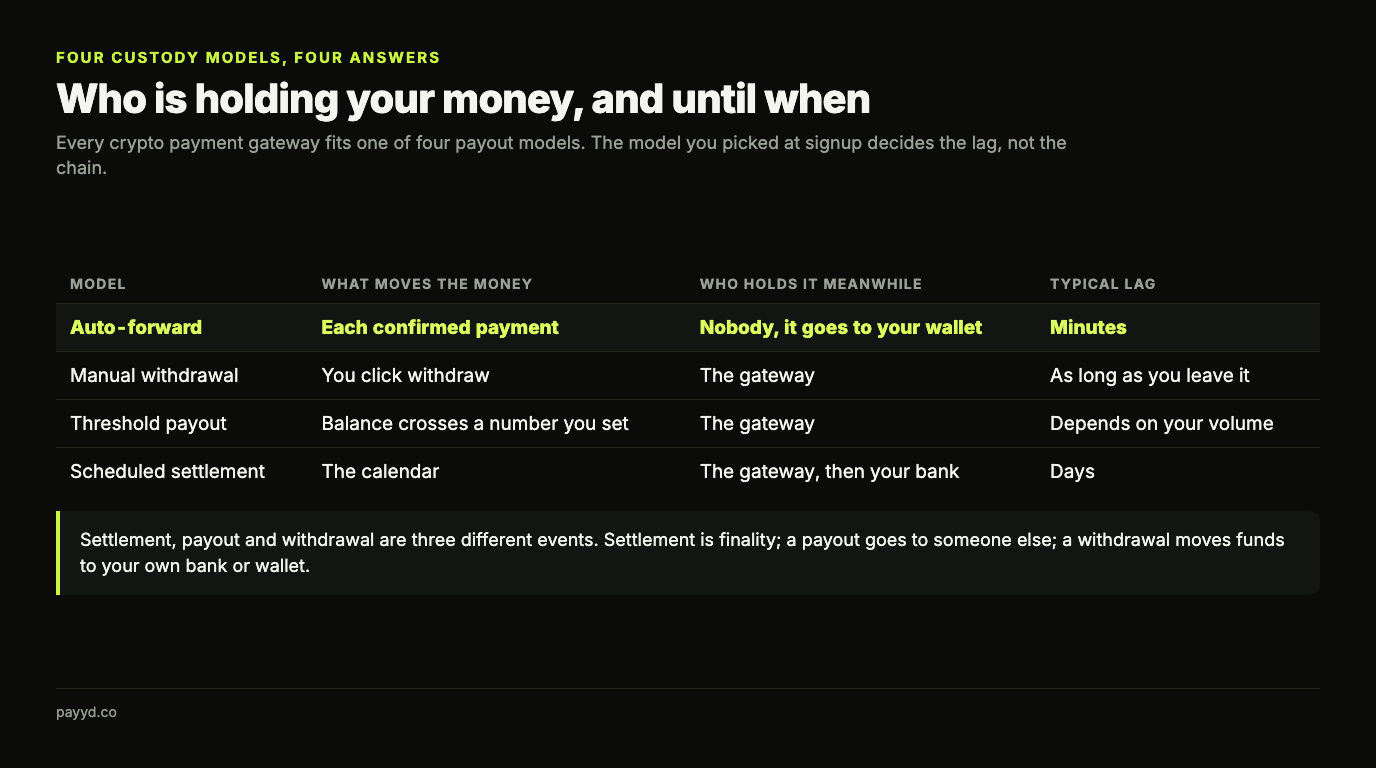
The useful realisation is that there is no single answer, because gateways do not share a payout design. There are four, and which one you are on was decided the moment you picked a custody model at signup:
| Model | What moves the money | Who holds it meanwhile | Typical lag |
|---|---|---|---|
| Auto-forward | Each confirmed payment | Nobody — it goes to your wallet | Minutes |
| Manual withdrawal | You click withdraw | The gateway | As long as you leave it |
| Threshold payout | Balance crosses a number you set | The gateway | Depends on your volume |
| Scheduled settlement | The calendar | The gateway, then your bank | Days |
Notice that only the fourth row involves a schedule in the everyday sense. Merchants coming from card processing expect a settlement calendar because that is how card rails work, and then go looking for one in a product that does not have it. Work out which row you are on first; the rest of this guide is the detail underneath each.
Settlement, payout, withdrawal: three words, three events
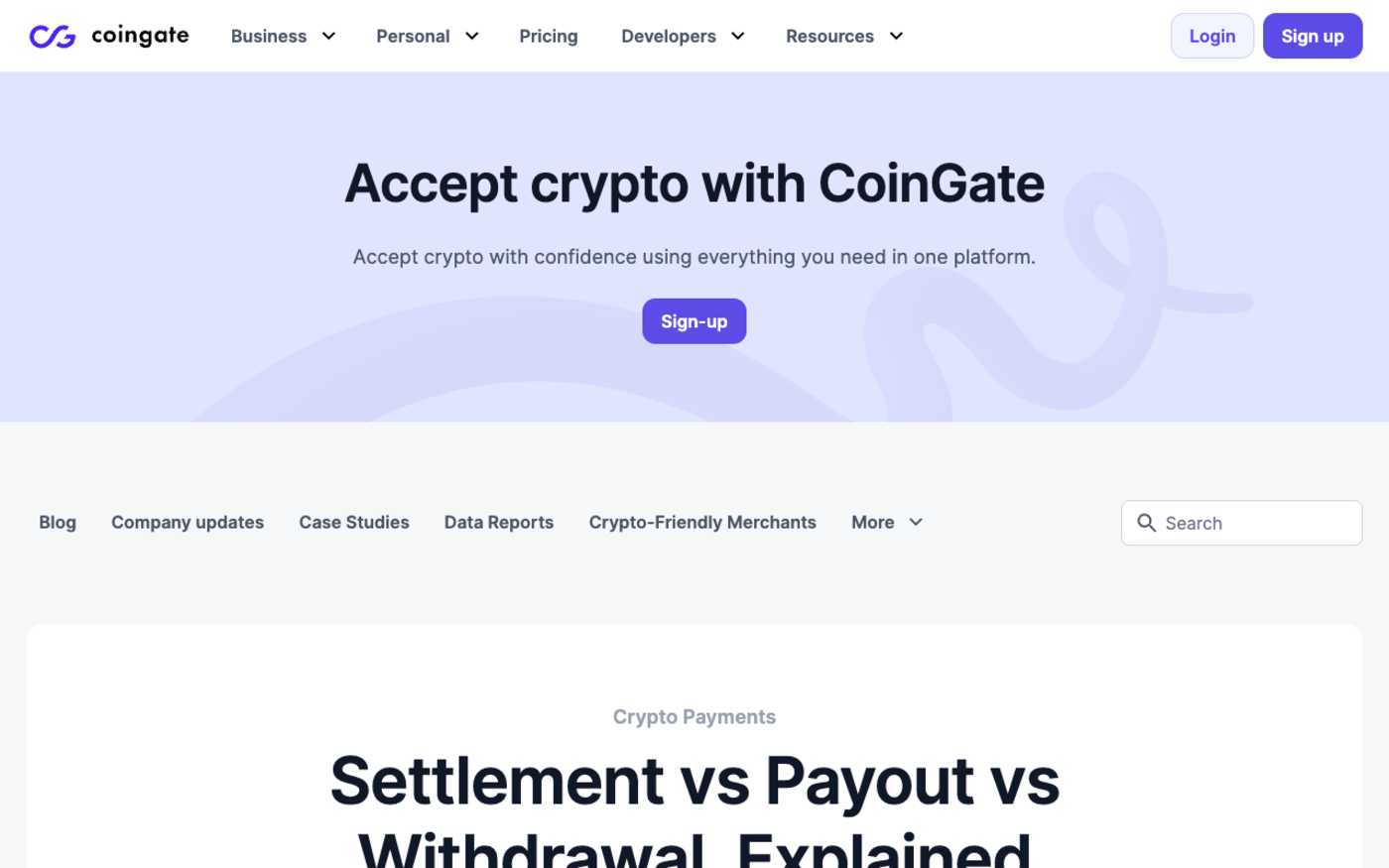
Before any of the numbers mean anything, the vocabulary has to stop shifting. CoinGate splits the three terms in a way worth borrowing wholesale, because its own dashboard uses them precisely and merchants reading it loosely misdiagnose delays that are not delays.
- Settlement is "the moment a payment becomes final" — the customer's payment is confirmed and can no longer be reversed. It says nothing about where the money is.
- A payout is "a transfer of funds to someone else", sent to external wallet addresses. CoinGate is explicit that this is not a withdrawal and does not move funds to your bank.
- A withdrawal "moves funds from CoinGate to your own bank account or crypto wallet". This is the one merchants actually mean when they ask when they get paid.
The confusion is expensive in a specific way. A gateway can show an invoice as settled while the money sits in your balance under a minimum you have not reached, and a merchant reconciling against invoice status will log revenue that is not spendable. This is the same failure that turns into a support ticket in our guide to a crypto payment that was not received — the last of the seven causes there is precisely this gap between received and settled. Reconcile against payout records, and keep the three words apart on purpose.
Model 1: auto-forward, where the money never stops
The fastest payout schedule is no payout schedule. In a non-custodial setup the gateway generates a deposit address, watches it, and pushes the funds onward the moment they confirm — there is no balance to release because nothing accumulates.
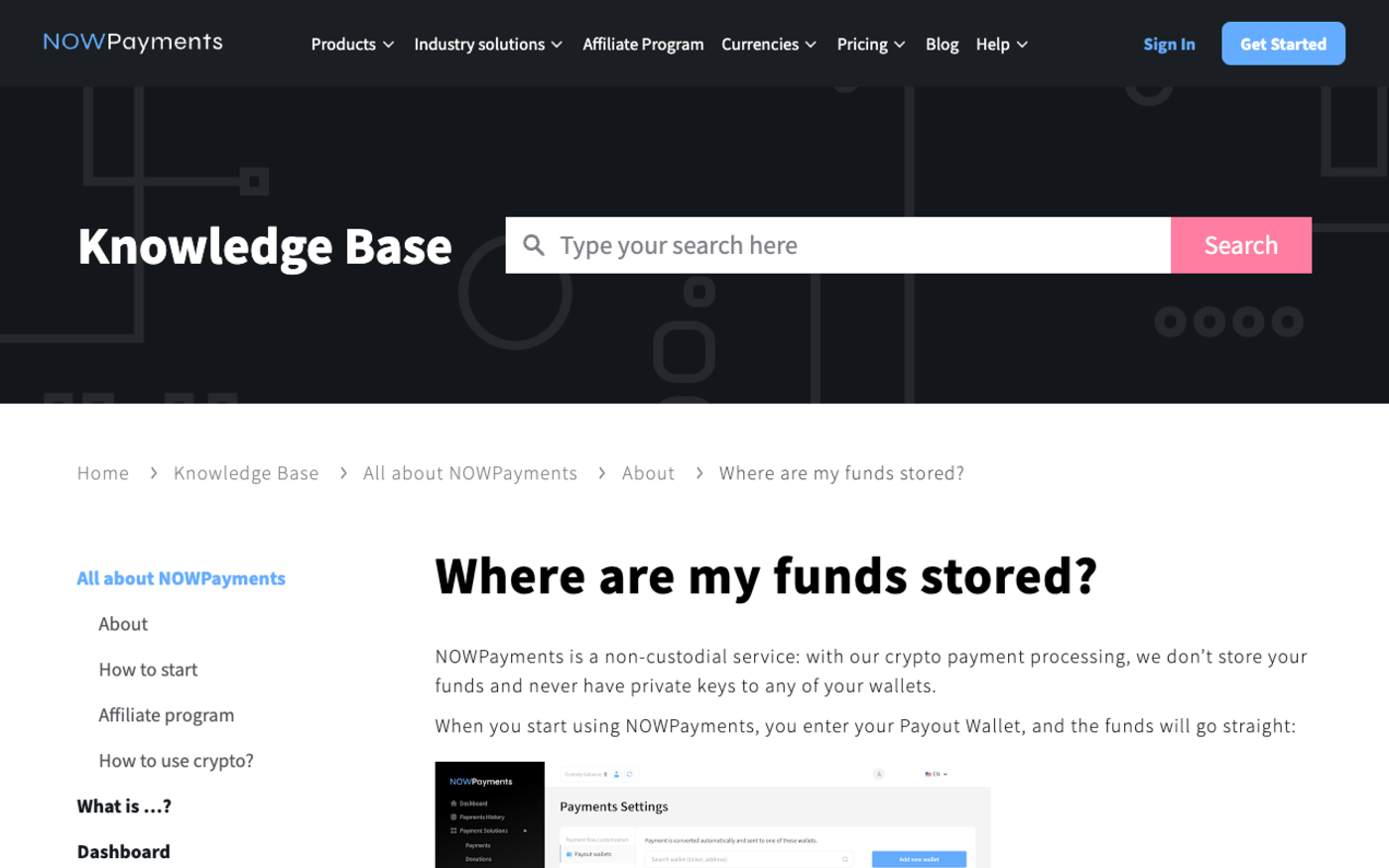
NOWPayments defaults to this. Its help pages state that it is a non-custodial service that does not store your funds and never has private keys to any of your wallets, and that when funds from the customer are received, the system sends them to your wallet immediately and automatically without any further storage. Customers still pay a NOWPayments deposit address rather than yours — that is how the payment is tracked against an invoice — but the hop onward is automatic. Its Custody option is an add-on that turns this off deliberately, pooling funds in a balance instead so you can batch withdrawals and pay one network fee rather than many.
BTCPay Server goes further by removing the intermediary entirely. Its wallet documentation explains that by default the server only requires an extended public key: you provide an xPub generated in an external wallet, and invoices are paid to addresses derived from it. There is no forwarding hop because there was never a custodial address to forward from. Payout latency equals block time, and the honest trade is that you carry the operational burden yourself — covered in our BTCPay Server setup guide.
The trade-off in this model is fees, not time. Every payment is its own on-chain transaction, so a store taking 200 small orders a month pays 200 network fees to receive them. That is the argument for the next two models, and it is a real one.
Model 2: a balance you withdraw yourself
Here payments credit an internal balance and nothing leaves until you say so. The cadence is yours, which sounds like freedom until you meet the per-asset minimum, because the floor is set in the coin rather than in your currency.
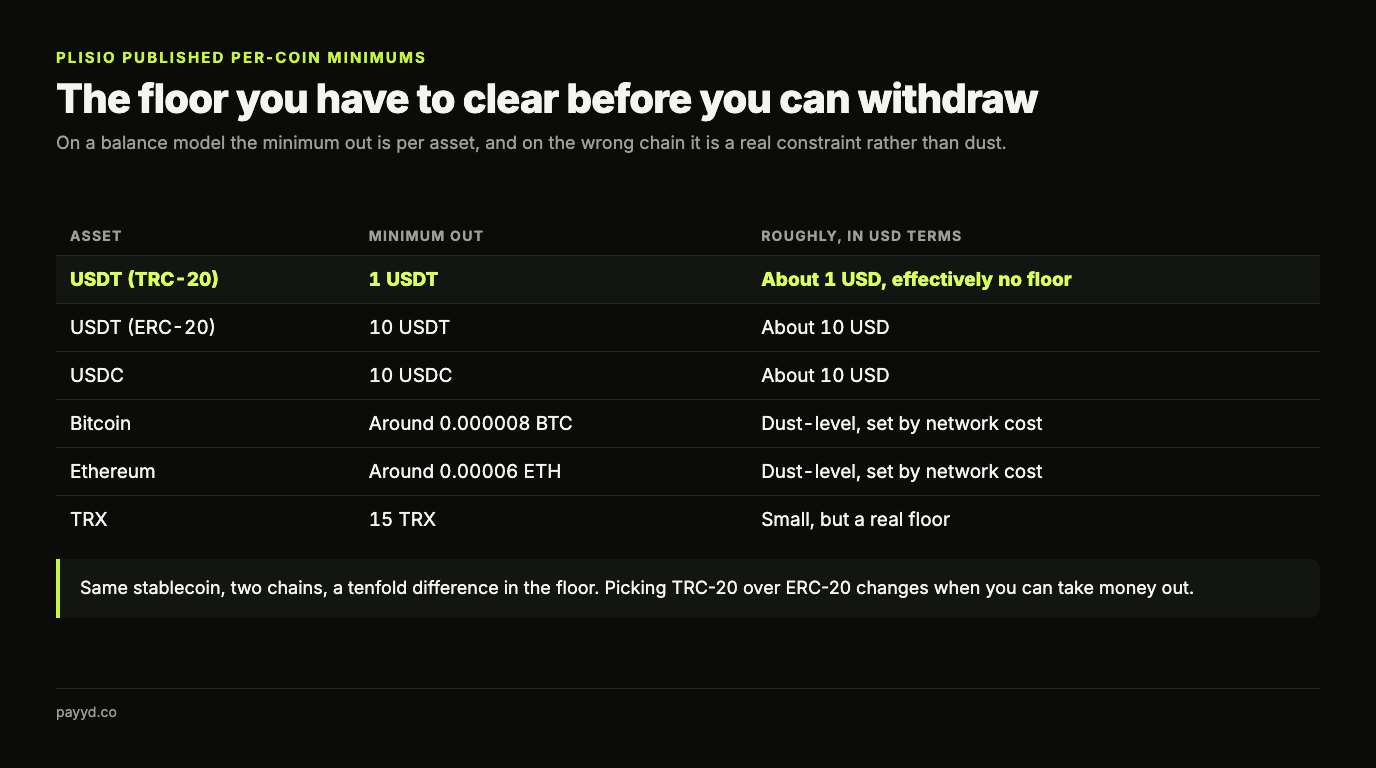
Plisio publishes its minimums per coin, and the spread across assets is the part worth planning around. These are its stated minimum amounts to send out, read from its own FAQ in September 2026:
| Asset | Minimum out | Roughly, in USD terms |
|---|---|---|
| USDT (TRC-20) | 1 USDT | About 1 USD — effectively no floor |
| USDT (ERC-20) | 10 USDT | About 10 USD |
| USDC | 10 USDC | About 10 USD |
| Bitcoin | Around 0.000008 BTC | Dust-level, set by network cost |
| Ethereum | Around 0.00006 ETH | Dust-level, set by network cost |
| TRX | 15 TRX | Small, but a real floor |
The pattern is that stablecoin floors are set in whole tokens and coin floors are set by what the network considers dust, which is why the same 10 USD of revenue is withdrawable as TRC-20 USDT and stuck as ERC-20 USDT. Plisio also lets you choose a Normal or Priority fee plan on the way out, trading cost against how quickly the transaction is included in a block — a lever most merchants never touch and should, because the default is not always the right side of that trade. Full context on rates sits in our gateway fee comparison.
Model 3: threshold-triggered auto-payout
This is the compromise between the first two, and it is under-used. Funds accumulate in a balance, but you configure an amount, and when the balance crosses it the gateway sends automatically. You get batched network fees without having to remember to click anything.
Cryptomus implements this as an auto-payout threshold set per currency in the merchant dashboard, sending to wallet addresses you nominate. Its published fee page puts incoming payment commission at 2% for new merchants with rates from 0.4% available on negotiation, and charges nothing for the auto-convert feature or for transfers between your own wallets. The withdrawal itself carries no platform commission — you pay the network fee.
The one design decision that matters here is where you set the threshold, and the instinct to set it low is usually wrong. Set it at a level where the network fee is a tolerable percentage of the transfer: a 3 USD fee on a 50 USD payout is 6% of your revenue, while the same fee on a 500 USD payout is 0.6%. On an expensive chain that difference is the whole margin on a small-ticket product. NOWPayments makes the same arithmetic explicit for its custody balances, noting that accepting several payments and withdrawing them in one transaction means paying one network fee instead of several.
Model 4: scheduled settlement with a bank leg
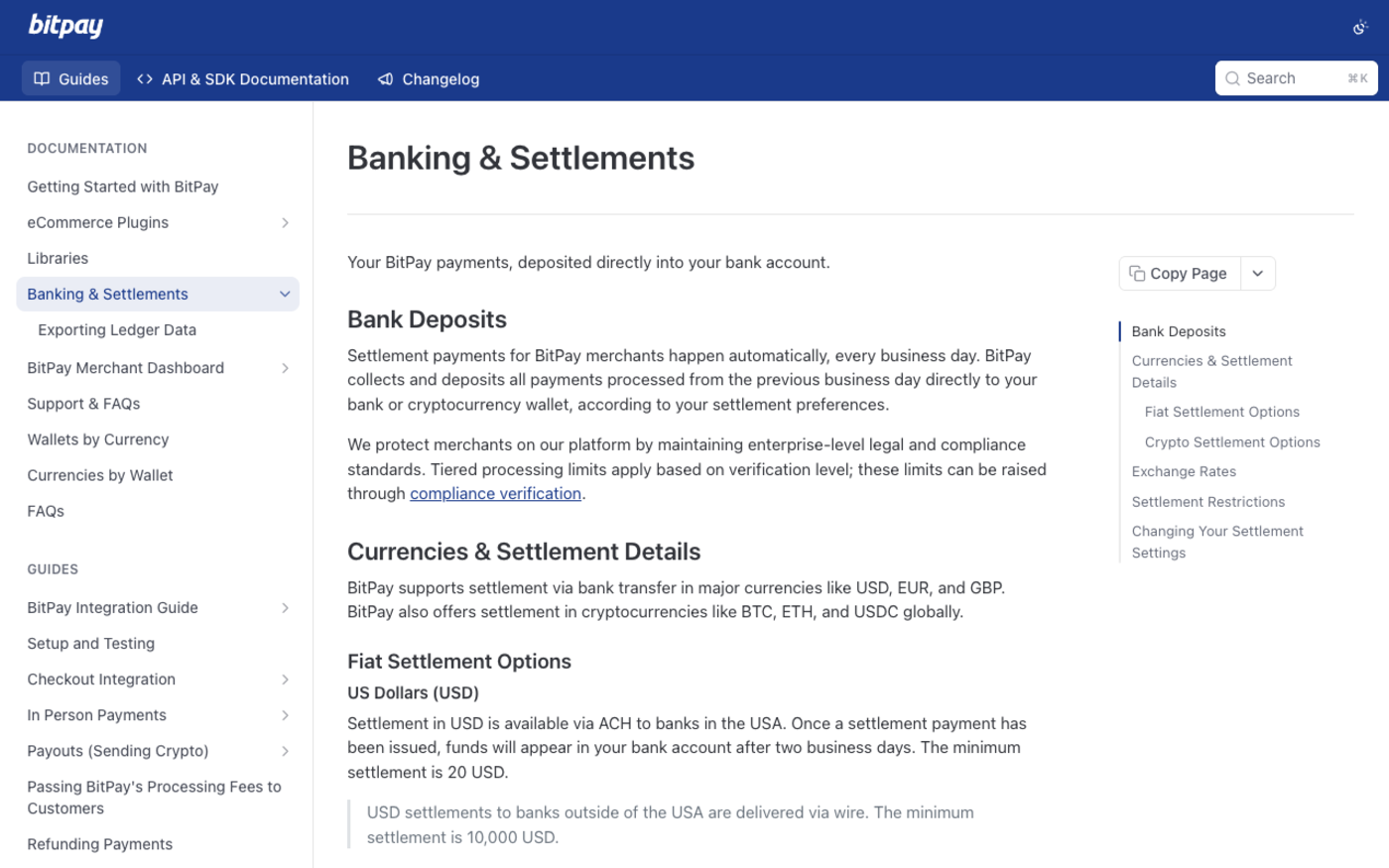
This is the model that looks most like card processing, and the one where the published cadence hides the most. Two gateways document their schedules clearly enough to compare, and they sit a long way apart.
CoinGate settles weekly. Its pricing page lists weekly automatic settlements on both the Standard and Enterprise plans, with an on-request option available only on Enterprise. Standard processing is 1% per transaction. Crypto withdrawals and SEPA transfers are free but subject to a 50 EUR minimum; SWIFT costs 0.50% with a 50 EUR minimum fee. You choose what you are settled in — convert everything to EUR for a fixed payout, settle in BTC, ETH, LTC or BCH, or pass DO_NOT_CONVERT and receive exactly the asset the customer paid.
BitPay settles every business day, which is the tightest published cadence of any custodial gateway here. Its settlement documentation states that settlement payments happen automatically every business day, and then adds the leg that catches people out — once a settlement payment has been issued, ACH funds appear in your bank account after two business days, while SEPA funds appear after one. The minimums vary sharply by rail:
| Rail | Gateway | Minimum | Arrives after issue |
|---|---|---|---|
| ACH (USD) | BitPay | 20 USD | 2 business days |
| SEPA (EUR) | BitPay | 500 EUR | 1 business day |
| Wire (USD) | BitPay | 10,000 USD | Not published |
| SEPA (EUR) | CoinGate | 50 EUR | Not published |
| SWIFT | CoinGate | 50 EUR fee minimum, 0.50% | Not published |
BitPay's other fiat minimums show the same asymmetry: 500 GBP, 500 CHF, 1,500 MXN, 2,500 AUD, 2,500 NZD and 5,000 CAD. A Canadian merchant needs 250 times the balance a US merchant does before a settlement is issued at all, which is a currency-availability problem masquerading as a payout schedule. If you are choosing on this basis, our regional guides for Europe and the USA go into which rails are realistically available where.
Skip the payout schedule entirely
NOWPayments forwards each confirmed payment straight to your own wallet by default — no balance, no minimum to clear, no weekly wait. Turn on custody later if you would rather batch. 0.5% fee, 300+ coins, no KYC to start.
Get a NOWPayments API Key →Every gateway's payout terms in one table
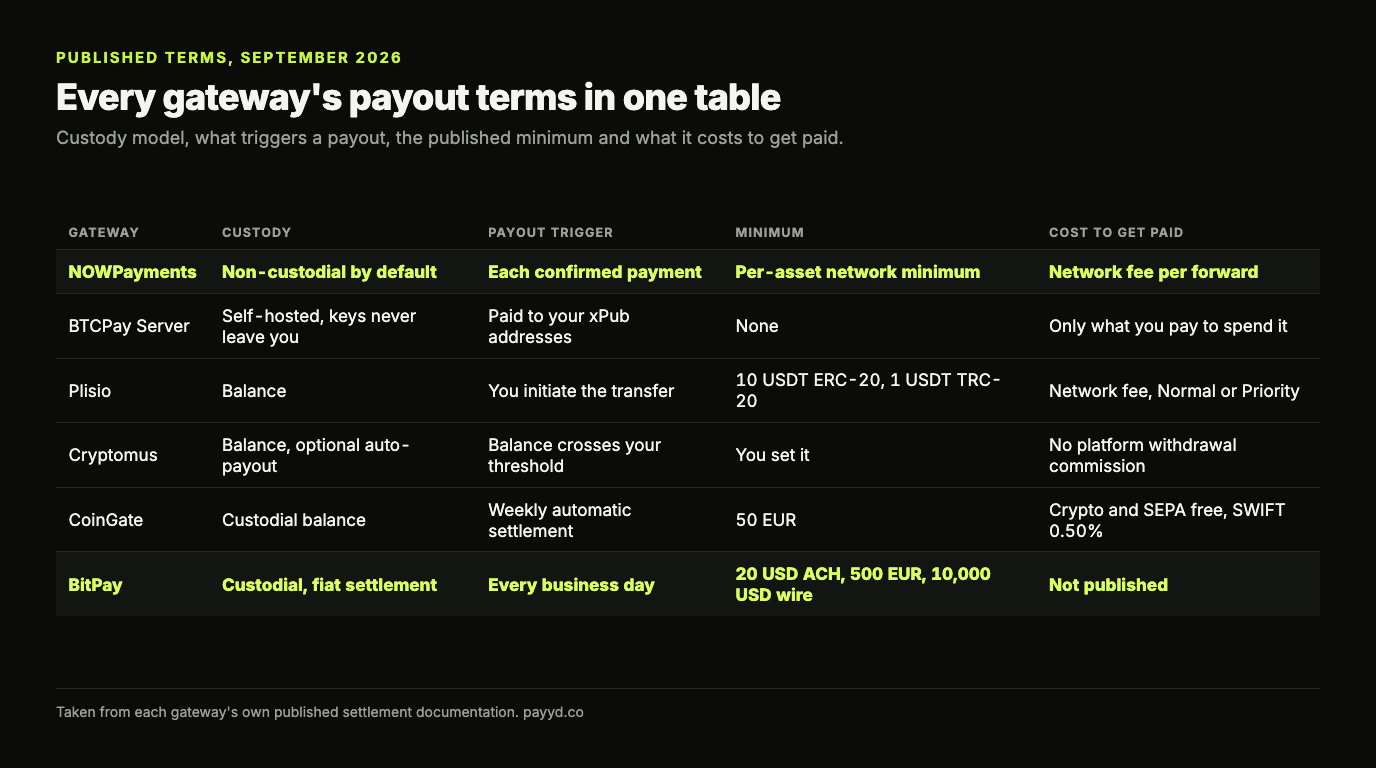
Read down the trigger column rather than the fee column. The trigger is what determines whether you are waiting, and it is the field no comparison post publishes:
| Gateway | Custody | Payout trigger | Minimum | Cost to get paid |
|---|---|---|---|---|
| NOWPayments | Non-custodial by default, custody optional | Each confirmed payment, automatically | Per-asset network minimum | Network fee per forward |
| BTCPay Server | Self-hosted, keys never leave you | None — paid to your xPub addresses | None | Only what you pay to spend it |
| Plisio | Balance | You initiate the transfer | Per coin: 10 USDT ERC-20, 1 USDT TRC-20 | Network fee, Normal or Priority |
| Cryptomus | Balance, optional auto-payout | Balance crosses your threshold | You set it | Network fee; no platform withdrawal commission |
| CoinGate | Custodial balance | Weekly automatic settlement | 50 EUR | Crypto and SEPA free; SWIFT 0.50% |
| BitPay | Custodial, fiat settlement | Every business day, automatically | 20 USD ACH, 500 EUR, 10,000 USD wire | Not published on the settlement doc |
One caveat on that last column. NOWPayments does not publish a single flat withdrawal minimum on a public page we could verify in September 2026 — third-party write-ups quote a 50 USD figure, but we could not source it to NOWPayments itself, so treat the per-asset network minimum as the binding constraint and check your own dashboard. We would rather leave a number out than repeat one we cannot stand behind.
Working out your real cash-conversion lag
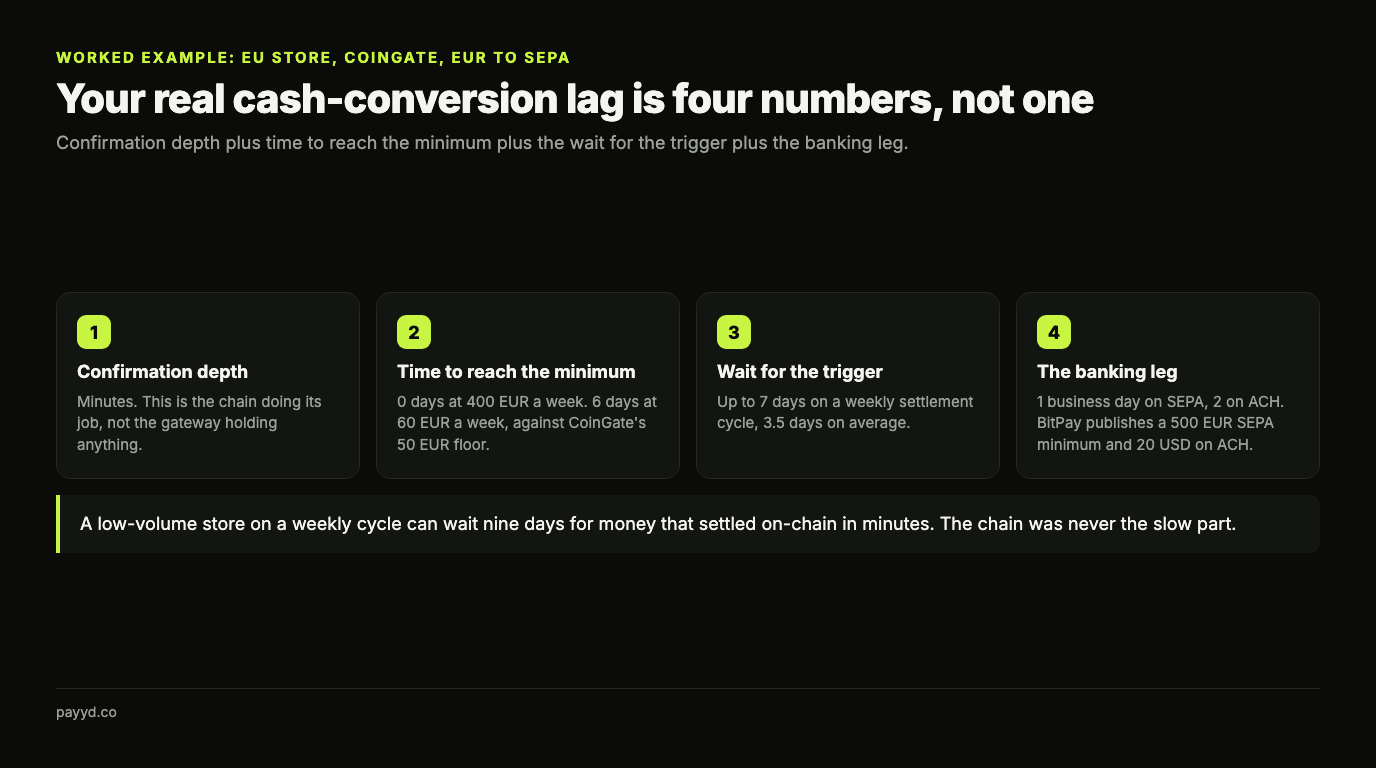
The number that matters to your business is not the cadence. It is the gap between a customer paying and you being able to spend the money, and it has four components that stack:
| Component | Worked example: EU store, CoinGate, EUR to SEPA |
|---|---|
| Confirmation depth | Minutes — the chain, not the gateway |
| Time to reach the minimum | 0 days at 400 EUR/week; 6 days at 60 EUR/week |
| Wait for the trigger | Up to 7 days on a weekly cycle; average 3.5 |
| Banking leg | 1 business day on SEPA, 2 on ACH |
Run it for a healthy store and the weekly cycle costs you about four and a half days on average. Run it for the merchant in the opening paragraph — 41 EUR against a 50 EUR floor — and the answer is that the money does not arrive at all until trade picks up, which no cadence on a pricing page would ever have told him. The floor dominates the schedule at low volume, and the schedule dominates the floor at high volume. Work out which side of that line your store is on before you choose, and if you are early, treat the minimum as the number to optimise. Merchants building on thin volumes will find more of this reasoning in our small business gateway guide.
One more variable that is easy to miss: a scheduled settlement releases what was settled by the cutoff, not what was paid. A payment that confirms an hour after the weekly cut waits a full extra cycle, so a store with lumpy weekend trade and a mid-week settlement can see a consistent extra week of lag on a third of its revenue for no reason it can see in the dashboard.
Which model fits your business
There is no best schedule, only a match between how you hold value and how you pay your costs. The deciding question is whether your bills are denominated in crypto or in fiat:
| If you are… | Choose | Because |
|---|---|---|
| Comfortable holding crypto, low order count | Auto-forward | No floor to clear, no counterparty holding your revenue |
| High order count, small tickets | Threshold payout | One network fee per batch instead of one per sale |
| Paying fiat costs — staff, rent, suppliers | Scheduled fiat settlement | Predictable arrivals, no manual conversion, no price exposure |
| Running your own infrastructure | Self-hosted, no payout step | Nothing to schedule when nobody else holds the keys |
| Paying out to others, not just receiving | A gateway with a real payouts product | Receiving and disbursing are different features |
That last row is the one merchants discover late. Paying suppliers or affiliates in crypto is a separate product from accepting payments, priced separately — CoinGate charges 0.50 EUR + 0.5% per crypto payout, rising to 0.50 EUR + 1.5% when the payout converts, and applies no minimum to payouts even though withdrawals carry a 50 EUR floor. If disbursement is a real part of your operation, our guide to crypto mass payouts covers that side properly.
Whichever model you land on, do one thing before you integrate: find the minimum, find the trigger, and multiply your realistic weekly revenue against both. It takes ten minutes and it is the difference between a payout schedule and a surprise.
FAQ
How long does a crypto payment gateway hold my money?
Anywhere from zero seconds to about nine days, depending on the custody model you chose at signup. A non-custodial gateway forwards each confirmed payment straight to your wallet, so nothing is held. A custodial one credits a balance and releases it on a trigger: CoinGate weekly, BitPay every business day. If the money then has to reach a bank, add the banking leg on top.
What is the difference between settlement, payout and withdrawal?
CoinGate treats them as three separate events. Settlement is the moment a payment becomes final and can no longer be reversed. A payout is a transfer of funds to someone else, sent to external wallet addresses, and is explicitly not a withdrawal. A withdrawal moves funds from the gateway to your own bank account or crypto wallet — the one merchants mean when they ask when they get paid.
Which crypto gateway pays out fastest?
Self-hosted BTCPay Server, because there is no payout step to be fast at — you supply an xPub and invoices are paid to addresses derived from your own wallet. NOWPayments in non-custodial mode is next: its help pages say funds are sent to your wallet immediately and automatically without any further storage. Neither can beat the chain itself.
What is the minimum withdrawal from a crypto payment gateway?
It varies by gateway and asset, and it is the figure most likely to strand your money. CoinGate publishes 50 EUR for crypto withdrawals and SEPA. BitPay needs 20 USD for ACH, 500 EUR or 500 GBP in Europe, and 10,000 USD for a wire. Plisio sets it per coin: roughly 0.000008 BTC, 10 USDT on ERC-20, but only 1 USDT on TRC-20.
Do I pay a fee to withdraw crypto from a gateway?
Usually just the network fee. CoinGate lists crypto withdrawals and SEPA transfers as free above the 50 EUR minimum and charges 0.50% on SWIFT with a 50 EUR minimum fee. Cryptomus advertises no withdrawal commission beyond the network fee. Plisio passes the miner fee through with a Normal or Priority choice. The expensive leg is conversion, not withdrawal.
Should I use a scheduled settlement or forward every payment?
Forward every payment for the shortest lag if you are comfortable holding crypto. Batch or schedule if your volume makes per-payment network fees a real cost, or if you need fiat in a bank account on a predictable date. Batching genuinely is cheaper: NOWPayments notes that withdrawing several payments in one transaction means one network fee instead of many.
How long does fiat settlement take to reach my bank?
The banking leg is separate from the gateway leg. BitPay documents that once a settlement has been issued, ACH funds appear after two business days and SEPA funds after one — on top of the wait for the settlement to be issued. A Friday sale on a weekly cycle with an ACH leg can realistically be spendable cash the following week.
Can I automate crypto payouts on a schedule?
Partly, and the feature is newer than most merchants realise. NOWPayments launched scheduled withdrawals in March 2026, but its own announcement says it is starting with one-time payments where you set a date and it sends once, with recurring options planned rather than shipped and access through the API while dashboard creation is still coming. Cryptomus takes the threshold route instead.
Affiliate disclosure: payyd.co earns a commission when readers sign up for NOWPayments, Plisio or CoinGate through our /go/ links. We have no affiliate relationship with BTCPay Server or BitPay and include them where they genuinely fit. Every minimum, fee and cadence in this article was read from the provider's own published documentation in September 2026 and is subject to change — check your own dashboard before relying on a number here. Gateway ordering reflects payyd's editorial criteria, not commission rates.