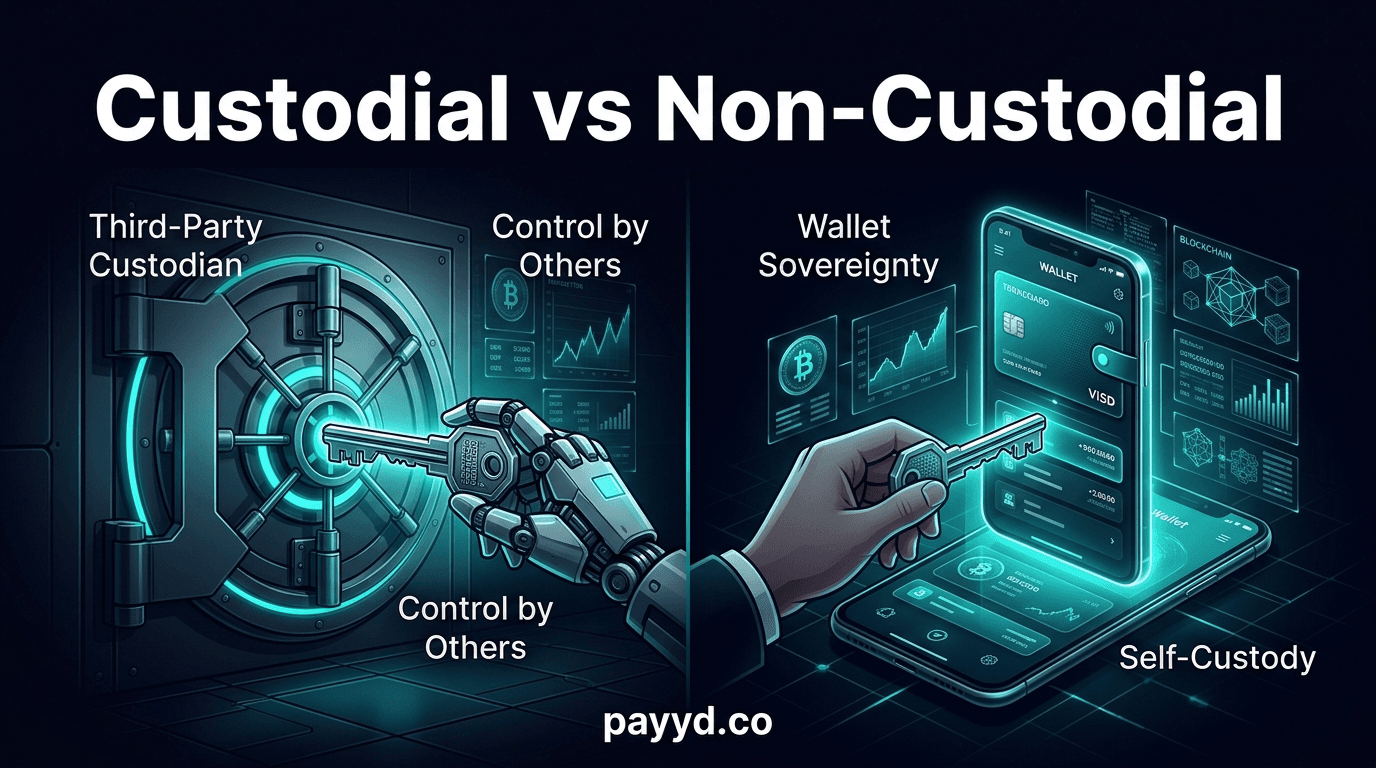
Custodial vs Non-Custodial Crypto: What It Means for Payments
Understand the difference between custodial and non-custodial crypto payment gateways. Risk comparison, which gateways are which, and when each model makes sense for your business.
Key Takeaways
- Custodial gateways hold your funds temporarily before forwarding them — convenient but you trust a third party with your money
- Non-custodial gateways route payments directly to your wallet — you maintain full control at all times
- Non-custodial options include BTCPay Server (0%), Coinremitter (0.23%), ATLOS (0.4%), PayGate.to (0.5%), and Paymento (0.5%)
- Custodial gateways often offer more features (fiat settlement, subscriptions) but carry counterparty risk
Every crypto payment gateway falls into one of two categories: custodial or non-custodial. This is not a minor technical detail — it determines who controls your money between the moment a customer pays and the moment funds reach your wallet. Getting this wrong can mean losing funds if a gateway gets hacked, goes bankrupt, or freezes your account.
I am going to explain both models plainly, show you which gateways fall into each category, and help you decide which is right for your business.
What Does Custodial Mean?
A custodial payment gateway temporarily holds your funds after a customer pays. The customer sends crypto to a wallet controlled by the gateway — not your wallet. The gateway then forwards the funds to you, typically after a short holding period or once you request a withdrawal.
During that holding period, the gateway has custody of your crypto. You are trusting them to keep it safe, not get hacked, not freeze your funds, and not go out of business before forwarding your money.
Custodial gateways: NOWPayments, Plisio, BitPay, CoinGate, CoinsPaid, BoomFi
How custodial flow works:
- Customer pays → funds go to the gateway's wallet
- Gateway holds funds (minutes to days depending on the service)
- Gateway forwards funds to your wallet (or converts to fiat and sends to your bank)
What Does Non-Custodial Mean?
A non-custodial payment gateway never touches your funds. Payments route directly from the customer's wallet to your wallet. The gateway provides the payment interface, generates invoices, monitors the blockchain for confirmations, and sends you notifications — but the money goes straight to an address you control.
If the gateway disappears tomorrow, your funds are safe because they were never in the gateway's possession.
Non-custodial gateways: BTCPay Server, Coinremitter, ATLOS, PayGate.to, Paymento, XAIGATE
How non-custodial flow works:
- Customer pays → funds go directly to your wallet
- Gateway monitors the blockchain and confirms payment
- Gateway notifies your system — that is it
Risk Comparison: Custodial vs Non-Custodial
Which Gateways Are Custodial vs Non-Custodial?
When Custodial Makes Sense
Custodial is not inherently bad — it is a trade-off. Here is when it makes sense:
- You need fiat settlement. Converting crypto to USD requires the gateway to hold and convert your funds. Only custodial gateways like BitPay and CoinGate offer this
- You want auto-conversion. Services like NOWPayments can automatically convert incoming altcoins to a stablecoin or your preferred crypto. This requires custody
- You need subscription billing. Recurring payment management requires the gateway to hold and process funds on a schedule
- You want mass payouts. Paying contractors or affiliates in crypto from a pooled balance requires custodial infrastructure
- You prioritize convenience over control. Custodial gateways handle more complexity for you — at the cost of trusting a third party
When Non-Custodial Makes Sense
- Security is your top priority. No counterparty risk means no one can lose or freeze your funds
- You operate in a regulatory gray area. Non-custodial gateways typically require no KYC, making them accessible to merchants worldwide
- You want maximum sovereignty. Your keys, your coins. BTCPay Server takes this to the extreme — self-hosted, open source, zero fees
- You have seen exchanges collapse. FTX, Mt. Gox, and dozens of other custodial services have lost customer funds. Non-custodial removes that risk entirely
- You are comfortable holding crypto. If you plan to keep payments in crypto rather than converting to fiat, non-custodial is strictly better
How to Choose the Right Model
Ask yourself two questions:
1. Do I need my crypto converted to fiat (USD/EUR)?
If yes, you need a custodial gateway. BitPay and CoinGate handle the conversion and deposit dollars to your bank. If no, non-custodial is safer.
2. Am I comfortable trusting a third party with my funds?
If yes, custodial gateways offer more features and convenience. If no, go non-custodial and keep full control.
For most merchants who are comfortable holding crypto, I recommend starting with a non-custodial gateway like Coinremitter (cheapest at 0.23%) or BTCPay Server (free but requires self-hosting). You can always add a custodial option later if you need fiat settlement.
See our best non-custodial gateways comparison for a deeper look at the non-custodial options.
Your Keys, Your Crypto
Non-custodial gateways let you accept payments without trusting a third party. Compare your options.
Compare Non-Custodial Gateways →Frequently Asked Questions
What happens to my funds if a custodial gateway gets hacked?
If a custodial gateway is hacked while holding your funds, you may lose them — just like an exchange hack. This is the primary risk of custodial solutions. Non-custodial gateways eliminate this risk because your funds go directly to your wallet.
Is NOWPayments custodial or non-custodial?
NOWPayments is custodial. They temporarily hold your funds before forwarding them. However, they have a solid track record since 2019 and offer withdrawal to your wallet on demand. The custodial model enables their auto-conversion and mass payout features.
Can a non-custodial gateway freeze my account?
A non-custodial gateway can technically disable your account on their platform, but they cannot touch your funds since payments already went to your wallet. With BTCPay Server (self-hosted), even account freezing is impossible because you control the entire infrastructure.
Is BTCPay Server really free?
BTCPay Server charges zero transaction fees. However, you need to pay for hosting (a VPS costs $5-20/month) and you pay standard blockchain network fees (which the customer typically covers). The software itself is completely free and open source.
Which custody model is better for high-volume merchants?
It depends on your priorities. For high-volume merchants who need fiat settlement, custodial gateways like CoinsPaid (with OTC desk) handle large volumes efficiently. For high-volume merchants who want to hold crypto, non-custodial is safer because you reduce counterparty risk as your holdings grow.
Can I use both custodial and non-custodial gateways?
Yes. Some merchants use a non-custodial gateway like Coinremitter for most transactions and a custodial gateway like BitPay for customers who want to pay with crypto but need the merchant to receive fiat. There is no conflict in running both simultaneously.
What does "not your keys, not your coins" mean?
This crypto mantra means that if you do not hold the private keys to a wallet, you do not truly own the crypto in it. Custodial gateways hold your keys temporarily. Non-custodial gateways let you use your own keys throughout the entire process.
Are non-custodial gateways harder to set up?
Not necessarily. Coinremitter and PayGate.to are non-custodial but offer simple hosted dashboards — setup takes minutes. BTCPay Server is the exception: it requires deploying your own server, which takes technical knowledge. Non-custodial does not always mean complicated.