Stablecoin Payments for Business 2026: USDT, USDC & DAI Explained
Complete guide to stablecoin payments for businesses. USDT vs USDC vs DAI compared, which gateways support stablecoins, MiCA regulations, and settlement advantages explained.
Key Takeaways
- Stablecoins eliminate crypto's biggest merchant objection — price volatility. Accept USDT or USDC and the value stays at $1
- USDT has the most liquidity, USDC has the best regulatory standing, DAI is decentralized — each serves different needs
- MiCA (EU) and US stablecoin regulations are reshaping which stablecoins gateways can support
- Most major gateways support stablecoins: NOWPayments, Coinremitter, BitPay, CoinGate, BoomFi, and others
The number one reason merchants reject crypto payments is volatility. "I accept $100 in Bitcoin and by the time I convert it, it is worth $92." That objection is valid — and stablecoins kill it entirely.
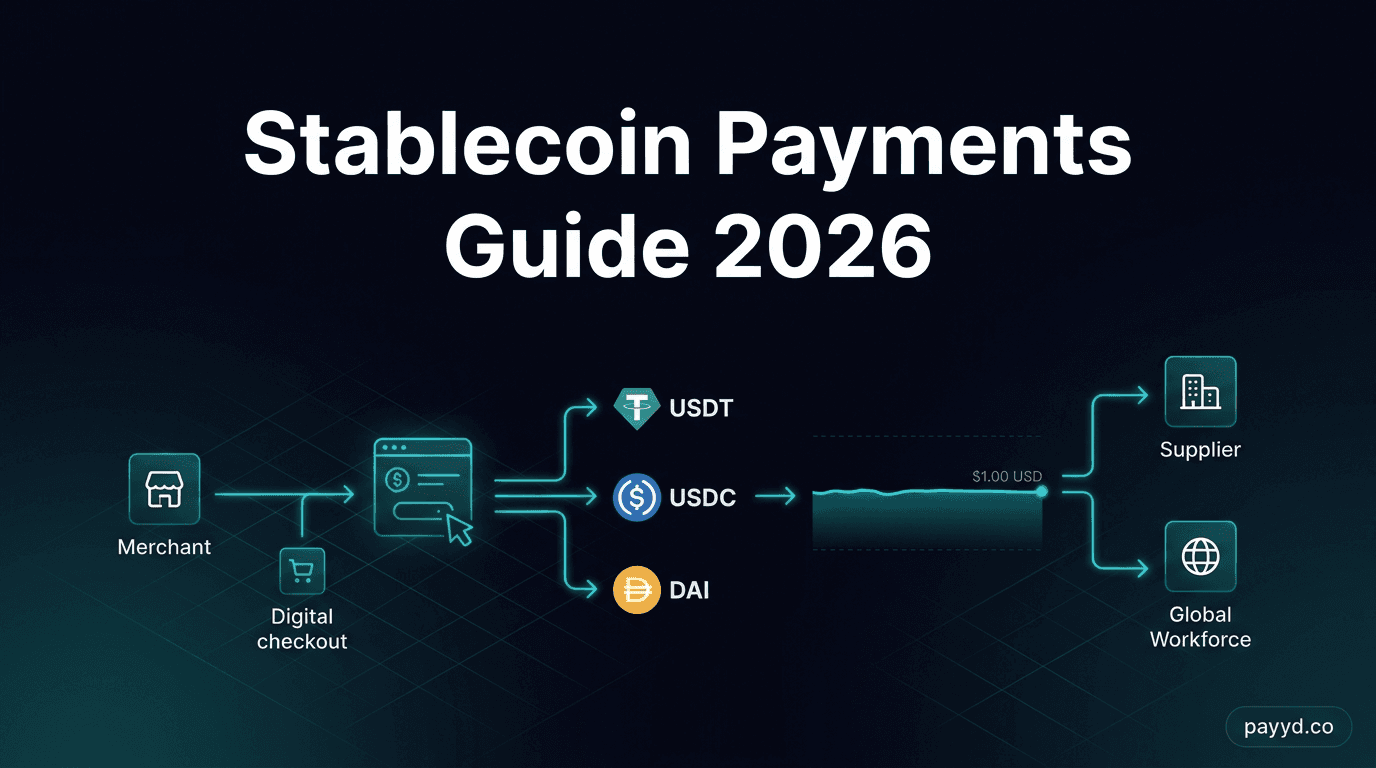
Stablecoins are cryptocurrencies pegged to a stable asset, almost always the US dollar. USDT, USDC, and DAI all maintain a 1:1 peg with USD. You accept 100 USDT, it is worth $100 today and $100 tomorrow. You get all the benefits of crypto payments — instant settlement, no chargebacks, global reach — without the volatility risk.
Why Stablecoins for Payments?
Stablecoins solve the specific problems that make merchants nervous about crypto:
- No price volatility — 1 USDT = 1 USD. Always. No checking prices nervously after receiving a payment.
- No off-ramp needed — stablecoins are already dollar-denominated. You can hold USDT/USDC indefinitely without worrying about value fluctuations.
- Lower fees than credit cards — stablecoin transfers on Tron or Polygon cost under $1. Compare that to 2.9% + $0.30 on Stripe.
- No chargebacks — blockchain transactions are irreversible. No more fraudulent chargebacks eating into your margins.
- 24/7 settlement — unlike bank wires that take 1-3 business days, stablecoin payments settle in minutes, any time, any day.
- Global by default — accept payments from any country without cross-border fees or currency conversion costs.
For merchants already considering accepting crypto payments, stablecoins are the lowest-risk entry point.
USDT vs USDC vs DAI
My Recommendation
For most merchants, accept both USDT and USDC. USDT has the most liquidity (your customers are most likely to hold it), and USDC has the strongest regulatory position (safest for your business long-term). DAI is worth offering if your customer base values decentralization.
Best Gateways for Stablecoin Payments
Not all crypto payment gateways handle stablecoins equally. Here are the best options:
NOWPayments offers the widest stablecoin support with the most chain options. Coinremitter has the lowest fees. For the full comparison, see our best crypto payment gateways 2026 guide.
Which Chain Should You Use?
The same stablecoin exists on multiple blockchains, and the chain you choose affects transaction speed, cost, and reliability:
- Tron (TRC-20) — Cheapest for USDT transfers. Fees under $1. Most USDT transactions happen on Tron. Recommended for cost-sensitive merchants.
- Ethereum (ERC-20) — Highest security and liquidity, but gas fees can be $5-50 during congestion. Best for high-value transactions where the fee is negligible.
- Polygon — Very low fees (pennies), growing ecosystem. Good for USDC payments.
- Solana — Sub-second finality, negligible fees. Growing stablecoin adoption. Good for real-time commerce.
- BSC (BEP-20) — Low fees but centralized. Popular in Asia.
My recommendation: encourage customers to pay with USDT on Tron (TRC-20) or USDC on Polygon for the lowest fees. Offer Ethereum as an option for customers who prefer it, but note that network fees will be higher.
Stablecoin Regulations (MiCA & US)
EU: MiCA Regulation
The Markets in Crypto-Assets (MiCA) regulation is the EU's comprehensive crypto regulatory framework. For stablecoins, MiCA requires:
- Stablecoin issuers must be authorized and supervised by EU regulators
- Reserves must be held 1:1 in regulated financial institutions
- USDC (Circle) has received MiCA authorization — it is compliant
- USDT's MiCA status is uncertain — some EU exchanges have delisted it
- DAI, being decentralized, exists in a regulatory gray area
For EU-based merchants, USDC is the safest choice under MiCA. If you serve European customers, ensure your gateway supports USDC prominently.
US Regulation
The US stablecoin regulatory landscape is still evolving. Key developments:
- USDC is issued by Circle, a US-based company with transparent reserve audits
- USDT has faced regulatory scrutiny but remains legal to use
- Proposed legislation would require stablecoin issuers to maintain full reserves and register with federal regulators
Settlement Advantages
Stablecoins offer concrete settlement advantages over both traditional crypto and fiat payments:
- vs Bitcoin/ETH: No volatility risk. You receive $100, it stays $100. No need to rush to an exchange before the price drops.
- vs Bank wires: Settle in minutes, not 1-3 business days. Available 24/7/365, including weekends and holidays.
- vs Credit cards: No 2.9% processing fees. No chargebacks. No 30-day settlement delays.
- vs PayPal: No account freezes. No 2.9% + $0.30 fees. No 21-day holds on new accounts.
For international B2B payments, stablecoins are particularly powerful. A cross-border USDT transfer costs under $1 and settles in minutes. The equivalent SWIFT wire costs $25-50 and takes 2-5 business days.
Start Accepting Stablecoin Payments
Compare gateways that support USDT, USDC, and DAI — find the lowest fees and best integration for your business.
Browse All Gateways →Frequently Asked Questions
What is a stablecoin payment?
A stablecoin payment uses a cryptocurrency pegged to a stable asset (usually the US dollar) for transactions. Unlike Bitcoin, which fluctuates, 1 USDT or 1 USDC always equals approximately $1. This eliminates volatility risk for both merchant and customer.
Which stablecoin is best for business payments?
For most businesses, accept both USDT and USDC. USDT has the highest liquidity (your customers are most likely to hold it). USDC has the strongest regulatory standing and is MiCA-compliant in the EU. DAI is best for businesses prioritizing censorship resistance.
Are stablecoin payments legal?
Yes, in most jurisdictions. Stablecoins are legal to use for payments in the US, EU, UK, and most countries. The EU's MiCA regulation provides a clear legal framework. Some countries may have specific restrictions — check local regulations.
Do stablecoins have fees?
Stablecoin transactions incur blockchain network fees (gas fees). On Tron, fees are under $1. On Ethereum, fees can be $5-50 depending on congestion. Payment gateway fees (0.23%-1%) apply on top of network fees.
Can Tether (USDT) lose its peg?
USDT has briefly depegged during market stress events but has always returned to $1. The main risk is around Tether Limited's reserve transparency. USDC, with its regular audits and US regulation, is considered lower risk. For maximum safety, hold a mix of both.
What is MiCA and how does it affect stablecoins?
MiCA (Markets in Crypto-Assets) is the EU's regulatory framework for cryptocurrencies. It requires stablecoin issuers to be authorized, hold proper reserves, and be supervised by EU regulators. USDC is MiCA-compliant. USDT's compliance status is uncertain, leading some EU exchanges to delist it.
Which chain has the lowest stablecoin transfer fees?
Tron (TRC-20) is cheapest for USDT — typically under $1 per transfer. Polygon and Solana are similarly cheap for USDC. Ethereum (ERC-20) is the most expensive, with fees ranging from $5 to $50+ during high congestion.
Can I accept stablecoins without KYC?
Yes. Several gateways accept stablecoin payments without KYC: Coinremitter (0.23%), XAIGATE (0.2%), and PayGate.to (0.5%) all support stablecoins with zero identity verification.