
Crypto Payment Networks 2026: Which Chain to Accept
We priced 11 crypto payment rails on 12 September 2026: TRC-20 USDT now costs 392x more than Ethereum, and your gateway sets the confirmation wait.

Key Takeaways
- TRON is no longer the cheap rail, and it is not close. Priced on 12 September 2026, a USDT payment cost $2.21-$4.43 over TRC-20 against $0.0056 on Ethereum — the network everyone calls expensive is now 392x to 787x cheaper for the same stablecoin.
- Your gateway's confirmation setting decides the wait, not the chain. BitPay's own docs put
highat zero confirmations,mediumat 1 andlowat 2 for Bitcoin. Same chain, same customer, three different checkout experiences. - "Ten minutes" is a mean, not a promise. The ten Bitcoin blocks before 966706 arrived 3.8 to 18.9 minutes apart. Half your customers wait longer than the number on your checkout page.
- Three rails charge a one-off cost nobody lists as a fee. A new Solana token account costs 0.00204 SOL ($0.21) in rent, an unfunded XRP address needs 1 XRP ($1.36) before it can receive anything, and Monero locks every received output for 10 blocks.
- Fast finality and cheap fees are not the same axis. BNB Chain blocks measured 0.45s and Solana slots 0.32s, but Ethereum — 12.05s blocks and ~15 minutes to finality — was the cheapest stablecoin rail of the day by two orders of magnitude.
Table of Contents
- The chain is a cost you never pay, which is why it gets picked badly
- Every rail, priced on the same afternoon
- TRON is not the cheap rail any more
- What "fast" actually measured today
- Your gateway sets the wait, not the blockchain
- The costs that never appear as fees
- Bitcoin's ten minutes is an average, not a promise
- How to actually pick the rails you offer
- FAQ
The chain is a cost you never pay, which is why it gets picked badly
Every gateway integration guide ends with a checkbox list of coins and networks, and almost nobody thinks about it for more than a minute. That is understandable — on a receive-only integration the network fee is paid by your customer, not by you, so it never appears on an invoice you have to sign. It is somebody else's money, which is exactly why it gets chosen from folklore rather than from data.
The stakes are the abandonment rate on your checkout page. A customer told to send $18 of USDT over TRC-20 today pays $2.21 to $4.43 in network fees on top — call it 12% to 25% of the order. The same payment on Ethereum costs them about half a cent. Nobody abandons a checkout because of your gateway's 0.5%; they abandon it when their wallet quotes a fee that makes the purchase look silly.
So I priced every rail a mainstream crypto payment gateway will offer you, straight off the chains: mempool.space for Bitcoin fee rates, public Ethereum, Polygon and BNB Chain RPC nodes for base fees and measured block times, TRON's own getchainparameters for the energy price, an eth_estimateGas call against the live USDT contract, and the XRP Ledger's server_info. Every number carries the date it was read, because most will be wrong within a month. This article prices the rails; our companion piece on crypto payment gateway fees compared prices the processors on top of them.
The short version: the received wisdom about which chain is cheap has quietly inverted, and the thing that decides how long your customer stares at a spinner is not the chain at all.
Every rail, priced on the same afternoon
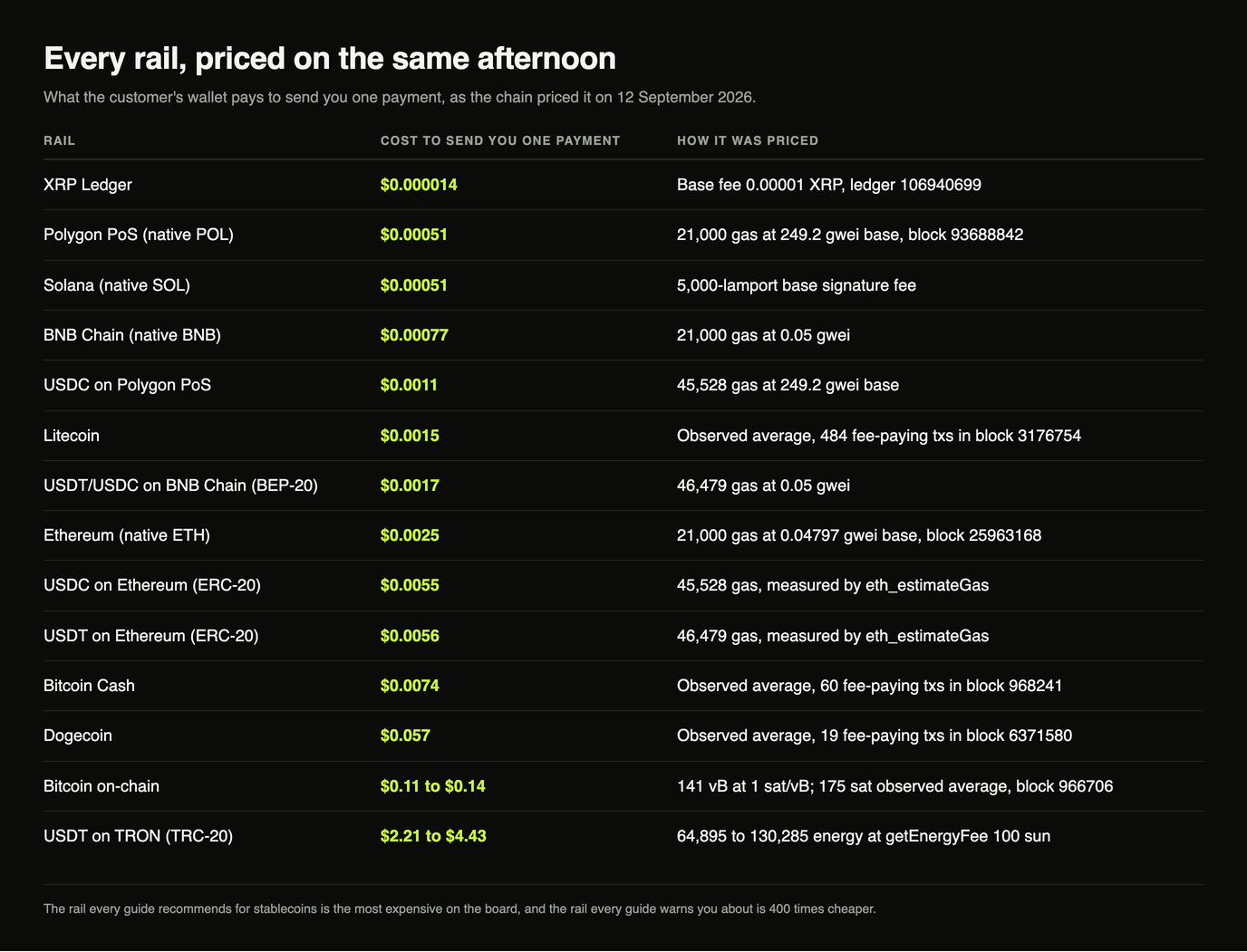
Here is the whole board. The cost column is what the customer's wallet pays to send you one payment — not what your gateway charges, not a monthly average from a chart, just the fee as the chain priced it on 12 September 2026. Where a rail has a documented per-transaction cost I computed it from live chain parameters; where the transaction size varies I used the average fee actually paid per transaction in that chain's most recent block.
| Rail | Cost to send you one payment | How it was priced |
|---|---|---|
| XRP Ledger | $0.000014 | Base fee 0.00001 XRP, ledger 106940699 |
| Polygon PoS (native POL) | $0.00051 | 21,000 gas at 249.2 gwei base, block 93688842 |
| Solana (native SOL) | $0.00051 | 5,000-lamport base signature fee |
| BNB Chain (native BNB) | $0.00077 | 21,000 gas at 0.05 gwei |
| USDC on Polygon PoS | $0.0011 | 45,528 gas at 249.2 gwei base |
| Litecoin | $0.0015 | Observed average, 484 fee-paying txs in block 3176754 |
| USDT/USDC on BNB Chain (BEP-20) | $0.0017 | 46,479 gas at 0.05 gwei |
| Ethereum (native ETH) | $0.0025 | 21,000 gas at 0.04797 gwei base, block 25963168 |
| USDC on Ethereum (ERC-20) | $0.0055 | 45,528 gas, measured by eth_estimateGas |
| USDT on Ethereum (ERC-20) | $0.0056 | 46,479 gas, measured by eth_estimateGas |
| Bitcoin Cash | $0.0074 | Observed average, 60 fee-paying txs in block 968241 |
| Dogecoin | $0.057 | Observed average, 19 fee-paying txs in block 6371580 |
| Bitcoin on-chain | $0.11-$0.14 | 141 vB at 1 sat/vB; 175 sat observed average, block 966706 |
| USDT on TRON (TRC-20) | $2.21-$4.43 | 64,895-130,285 energy at getEnergyFee 100 sun |
Read that bottom row against the two highlighted ones. The rail every guide recommends for stablecoins is the most expensive rail on the board, and the rail every guide warns you about is 400 times cheaper. That is not a rounding difference or a quiet off-peak window — it is the entire conventional wisdom pointing the wrong way, and it deserves its own section.
TRON is not the cheap rail any more
Search for which network to accept USDT on and you will be told, confidently and everywhere, that TRC-20 costs "under a dollar regardless of amount" while ERC-20 "can reach $10-$20 during congestion". That was true for years. It is not true today, and the reason is that both halves of the comparison moved at once.
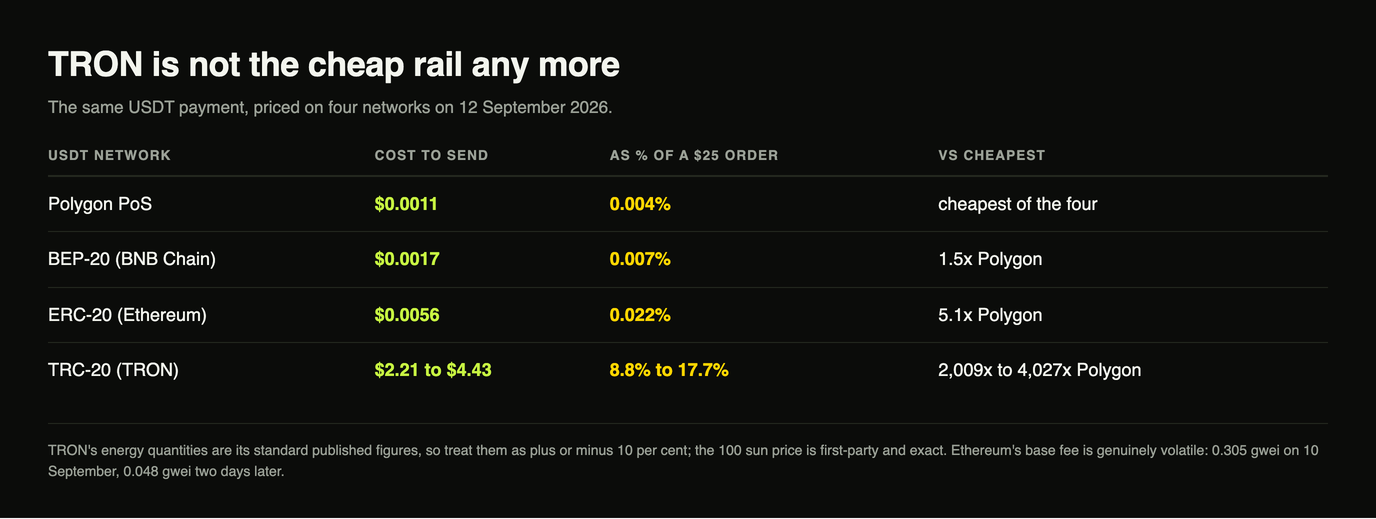
TRON prices transactions in energy, and energy's price is an on-chain governance parameter. Reading getchainparameters from a TRON node on 12 September 2026, getEnergyFee returns 100 sun per unit of energy. A USDT transfer burns roughly 64,895 energy when the recipient already holds USDT, and about 130,285 when it has to initialise the recipient's balance slot. Multiply either by 100 sun and you get 6.49 to 13.03 TRX — at $0.340 per TRX, $2.21 to $4.43.
Ethereum went the other way. Its base fee on block 25963168 was 0.04797 gwei — not 48 gwei, not 4.8, but under five hundredths of one gwei, confirmed identically by two independent public RPC nodes. And rather than trust a folklore gas figure, I asked the chain what a real USDT transfer costs by running eth_estimateGas against the live Tether contract: 46,479 gas. That is the whole calculation — 46,479 × 0.04797 gwei × $2,523.76.
| USDT network | Cost to send | As % of a $25 order | vs cheapest |
|---|---|---|---|
| BEP-20 (BNB Chain) | $0.0017 | 0.007% | baseline |
| Polygon PoS | $0.0011 | 0.004% | cheapest of the four |
| ERC-20 (Ethereum) | $0.0056 | 0.022% | 5.1x Polygon |
| TRC-20 (TRON) | $2.21-$4.43 | 8.8%-17.7% | 2,009x-4,027x Polygon |
Two honest caveats, because this table will be quoted at people. First, the energy quantities are TRON's standard published figures rather than something I measured on-chain, so treat them as ±10%; the 100 sun price is first-party and exact. Second, Ethereum's base fee is genuinely volatile — it was 0.305 gwei when we priced merchant refunds on 10 September and 0.048 gwei two days later, a 6x move in 48 hours. TRON's energy price is a governance parameter that changes rarely and in one direction. Ethereum will sometimes be dearer than today; TRON will not be suddenly cheap.
The upshot is short. If you offer USDT, offer it on more than one network and let the customer's wallet show them the fee. If you offer it on exactly one network and that network is TRON because a listicle said so, you are charging a double-digit surcharge on small orders and calling it cheap. Our guides to accepting USDT payments and accepting TRON payments go deeper on each rail.
What "fast" actually measured today
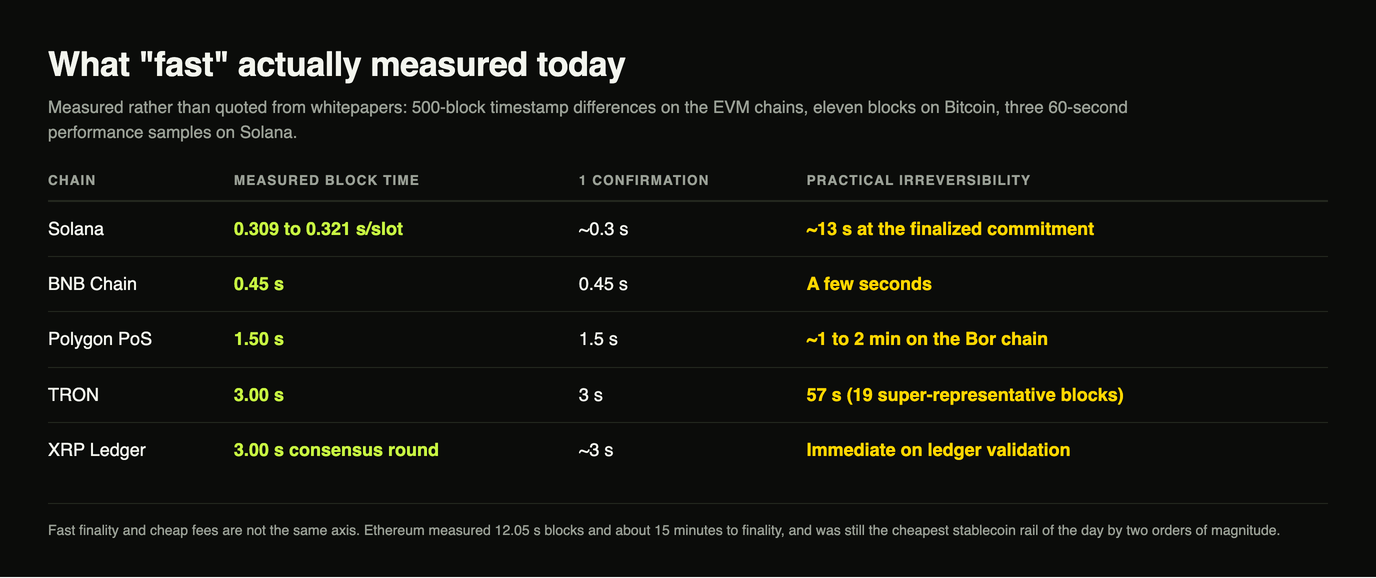
Speed claims in this industry are quoted from whitepapers, so I measured them instead. For each EVM chain I took the timestamp difference across the most recent 500 blocks; for Bitcoin, the intervals between the last eleven blocks; for Solana, three consecutive 60-second performance samples from a mainnet node. All on 12 September 2026.
| Chain | Measured block time | 1 confirmation | Practical irreversibility |
|---|---|---|---|
| Solana | 0.309-0.321 s/slot | ~0.3 s | ~13 s at the finalized commitment |
| BNB Chain | 0.45 s | 0.45 s | A few seconds |
| Polygon PoS | 1.50 s | 1.5 s | ~1-2 min on the Bor chain |
| TRON | 3.00 s | 3 s | 57 s (19 super-representative blocks) |
| XRP Ledger | 3.00 s consensus round | ~3 s | Immediate on ledger validation |
| Ethereum | 12.05 s | 12 s | ~15 min (two epochs, per ethereum.org) |
| Litecoin | 2.5 min target | ~2.5 min | ~15 min at 6 blocks |
| Monero | 2 min target | ~2 min | ~20 min minimum (10-block unlock, protocol-enforced) |
| Bitcoin | 8.79 min mean, 3.8-18.9 min range | 3.8-18.9 min | ~53 min at 6 blocks, observed |
The ordering here has almost nothing in common with the fee table. Ethereum is simultaneously the cheapest major stablecoin rail and the slowest to real finality of the fast chains — 15 minutes, in ethereum.org's own words, because a block needs two epochs to finalise. TRON is 3-second blocks but needs 19 of them before its delegated-proof-of-stake consensus calls a block irreversible, so 57 seconds is the honest figure rather than three. And Monero's 20 minutes is not a policy you can tune — it is the protocol refusing to let the recipient spend the output.
Which raises the question that actually determines your customer's experience: who decides how many of those confirmations you wait for?
Your gateway sets the wait, not the blockchain
This is the part the chain-comparison articles all miss. The number of confirmations you wait for is a setting in your gateway dashboard, not a property of the network, and the gap between the loosest and strictest setting on one chain is larger than the gap between most chains.
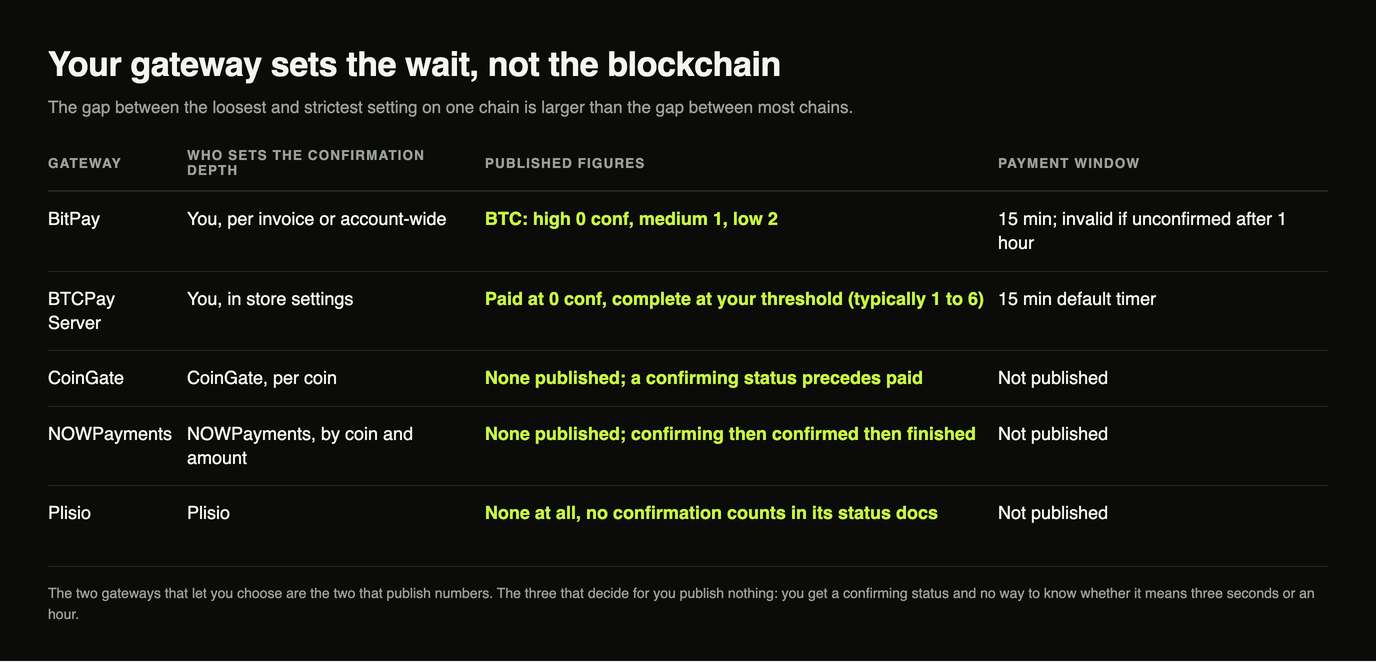
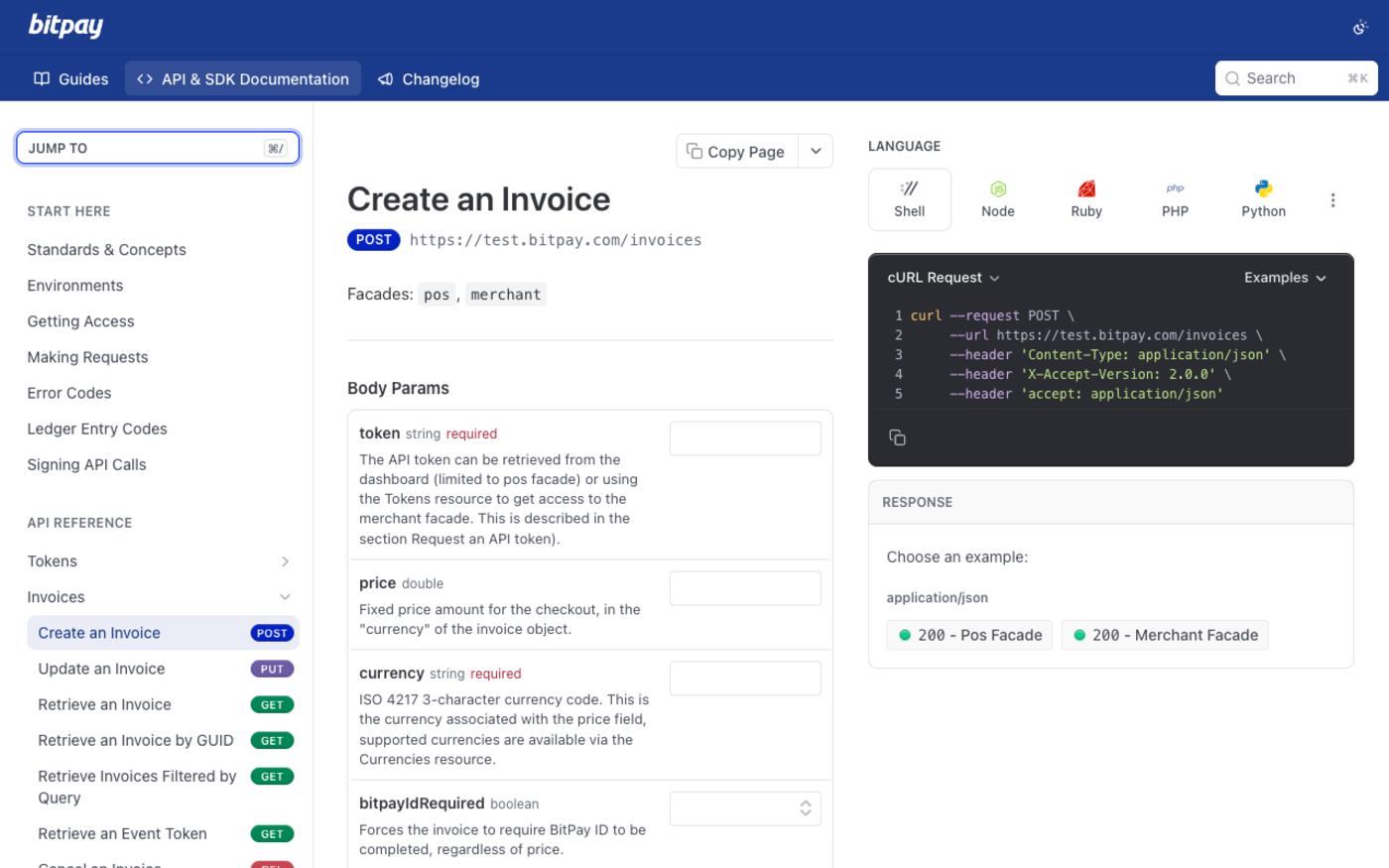
BitPay documents the trade-off precisely. Its integration documentation defines a transactionSpeed parameter with three values. At high, "the invoice is marked as 'confirmed' by BitPay as soon as full payment is received (but not yet validated on the corresponding blockchain)" — zero confirmations, and BitPay carries the double-spend risk. At medium, "for invoices paid in Bitcoin (BTC), this means 1 confirmation on the blockchain, which takes on average 10 minutes". At low, two confirmations and about twenty minutes. Settlement is a separate track: orders "are only credited to your BitPay Account Summary for settlement after the invoice reaches the status 'complete'".
| Gateway | Who sets the confirmation depth | Published figures | Payment window |
|---|---|---|---|
| BitPay | You, per invoice or account-wide | BTC: high 0 conf, medium 1, low 2 | 15 min; invalid if unconfirmed after 1 hour |
| BTCPay Server | You, in store settings | Paid at 0 conf, complete at your threshold (typically 1-6) | 15 min default timer |
| CoinGate | CoinGate, per coin | None published; a confirming status precedes paid | Not published |
| NOWPayments | NOWPayments, by coin and amount | None published; confirming then confirmed then finished | Not published |
| Plisio | Plisio | None at all — no confirmation counts in its status docs | Not published |
Notice the shape of that table. The two gateways that let you choose are the two that publish numbers, and the three that decide for you publish nothing — you get a confirming status and no way to know whether it means three seconds or an hour. CoinGate's order-status reference documents the state machine without a single confirmation count, and Plisio's status documentation lists New, Pending, Completed, Underpaid, Cancelled/Expired and Error with no confirmation policy anywhere.
BitPay's invalid state is the one to design around: a payment that arrives but does not confirm within an hour is marked invalid, not paid. On a chain where your customer's wallet underpays the fee, that hour is a real risk rather than a theoretical one — and it is the most common cause behind our guide to crypto payments that never arrive. If you are choosing between processors on this axis, our BitPay vs CoinGate vs BTCPay comparison covers the rest of the trade-off.
Offer the rail, don't pick it for the customer
The cheapest fix for the TRC-20 problem is breadth: let the customer's own wallet show them the fee and choose. NOWPayments carries 300+ assets across every network in the tables above, forwards each payment straight to your wallet, and charges 0.5% with no KYC to start.
Get a NOWPayments API Key →The costs that never appear as fees
Three rails in the fee table carry a charge that is not a transaction fee, does not show up in any comparison chart, and lands on whoever is unlucky enough to be new. Each one has bitten a real merchant.
Solana charges rent for the account that holds your tokens. The 5,000-lamport base fee is half a thousandth of a cent, but an SPL token like USDC lives in an associated token account, and creating one costs a rent-exempt deposit of about 0.00204 SOL — $0.21 today. It is one-off and refundable if you close the account, but the first USDC payment to a fresh Solana address costs four hundred times the second, and a wallet holding no SOL cannot receive USDC at all.
An XRP address does not exist until somebody funds it. The XRP Ledger's server_info reports a reserve_base_xrp of 1 XRP and a reserve_inc_xrp of 0.2, so your new receiving address needs $1.36 parked in it permanently before a payment can land. The cheapest rail on the board is also the only one with a setup cost you fund yourself.
The Monero one is worse than a cost — it is a bug surface.
Monero locks every received output for 10 confirmations before it can be spent, so about 20 minutes at 2-minute blocks, and the sender can set an additional arbitrary unlock time on top. The Monero project's own May 2026 deprecation notice says the quiet part out loud: merchant software "has neglected to check the Unlock Time on received Monero, and incorrectly assumed that the Monero received is spendable, leading to losses". If you accept XMR through anything other than a well-maintained integration, check that it reads unlock time. See our guide to accepting Monero for the rest.
The general lesson is that per-transaction fees are the only cost anyone benchmarks, so they are the only cost chain marketing optimises. Account rent, address reserves and spend locks are all real money or real delay, and none of them appear in a fee comparison — including, until this section, mine.
Bitcoin's ten minutes is an average, not a promise
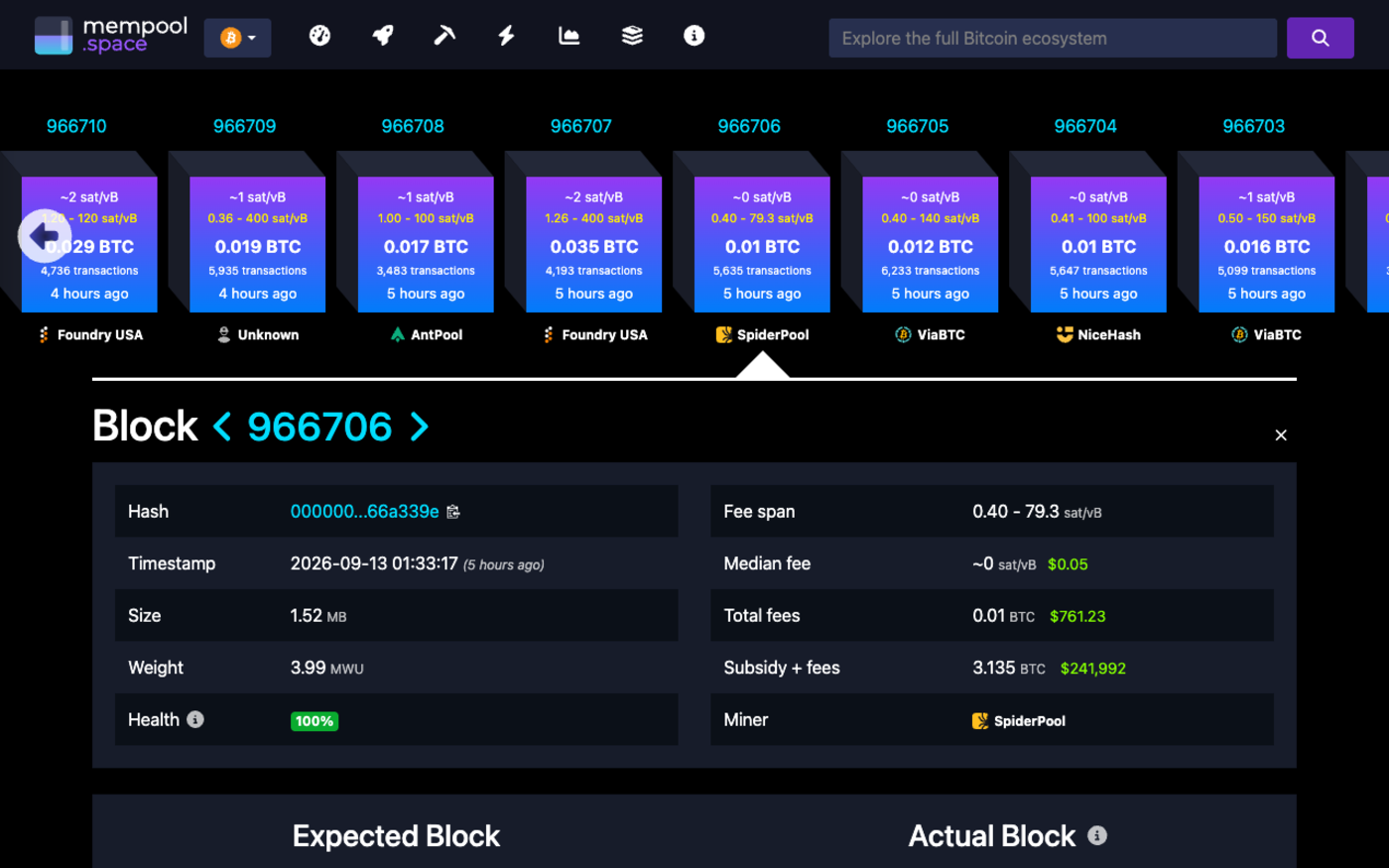
Every Bitcoin checkout page in the world says roughly ten minutes. Bitcoin mining is a Poisson process, which means the interval between blocks is exponentially distributed around that target — the mean is ten minutes and the mode is zero. Here are the actual intervals between the eleven most recent blocks, ending at height 966706 on 12 September 2026.
| Interval | Seconds | Minutes | vs the "10 minutes" on your checkout |
|---|---|---|---|
| Fastest observed | 229 | 3.8 | 2.6x faster than promised |
| Median of the ten | ~489 | 8.1 | About right |
| Mean of the ten | 527 | 8.8 | About right |
| Slowest observed | 1,135 | 18.9 | Nearly 2x slower |
A five-fold spread across ten consecutive blocks, on an ordinary Saturday with an empty mempool. If your gateway waits two confirmations, the honest range to show a Bitcoin customer is eight to thirty-eight minutes, not twenty. At six confirmations that is 53 minutes at the observed mean — touching distance of BitPay's one-hour invalid threshold.
The fee side was just as quiet. mempool.space returned 1 sat/vB across every priority tier — fastest, half-hour, hour and economy all the same number, which happens only when nothing is competing for space. Block 966706's median fee rate was 0.44 sat/vB, so transactions paying less than the notional minimum were confirming fine. That is the environment in which Bitcoin costs eleven cents; it is not the environment of the 2024 fee spikes, and it will not last. If sub-cent Bitcoin matters to you, Lightning is the structural answer rather than a calm mempool.
How to actually pick the rails you offer
Three decisions, in this order, and the first one does most of the work.
Decide by order size, not by chain. A network fee only matters relative to the basket. At a $200 average order, every rail in the fee table except TRC-20 costs the customer under a tenth of a percent and the choice is irrelevant. At a $9 digital download, the same table is the difference between a 0.06% surcharge and a 49% one. Work out what your fee-to-order ratio is before you have an opinion about blockchains.
| Your situation | Offer first | Why |
|---|---|---|
| Digital goods under $20 | Stablecoins on Polygon or BNB Chain, plus Lightning | Sub-cent fees and sub-2-second blocks; fee is under 0.01% of the order |
| Physical goods, $50-$500 | USDT/USDC on Ethereum and one L2, plus BTC on-chain | Fees are noise at this size; take the deepest liquidity and best wallet support |
| B2B invoices over $1,000 | Stablecoins on Ethereum; wait for real finality | 15 minutes to two-epoch finality is cheap insurance on a five-figure payment |
| In-person or point of sale | Lightning, Solana, BNB Chain | Nobody stands at a counter for 8.8 minutes; sub-second blocks are the only option |
| Customers paying from exchanges | Whatever their exchange withdraws cheapest | Exchange withdrawal fees are flat and often dwarf the chain fee — the one case where TRC-20 can still win |
Then set your confirmation policy to match your fulfilment risk, not your nerves. If you ship physical goods days later, zero confirmations costs you nothing — a reorg would surface long before the parcel leaves. If you deliver a licence key instantly, you carry the double-spend risk and one confirmation on a fast chain is the right trade. The mistake is a six-confirmation default on an instantly-fulfilled product, then blaming Bitcoin for the abandonment.
Finally, offer breadth and let the wallet do the arguing. Every chain in these tables was somebody's obvious answer eighteen months ago, and the TRON numbers show how fast an obvious answer rots. Thirty networks cost the same as five, and the customer's wallet quotes them the fee — a better optimiser than either of us. Our guide to accepting crypto payments covers the integration, and crypto payout schedules covers what happens to the money afterwards.
FAQ
Which blockchain is cheapest for accepting crypto payments?
On 12 September 2026 the XRP Ledger was cheapest at $0.000014 per transaction, followed by Polygon PoS and Solana at about $0.0005 for a native transfer. For stablecoins specifically, Polygon PoS at $0.0011 and BNB Chain at $0.0017 beat Ethereum's $0.0056. All four are so far below a cent that the deciding factor should be wallet support, not fees.
Is TRC-20 still cheaper than ERC-20 for USDT?
No, and the gap is enormous in the other direction. TRON's getEnergyFee parameter reads 100 sun, which puts a USDT transfer at 6.49 to 13.03 TRX, or $2.21 to $4.43. The same transfer on Ethereum used 46,479 gas at a 0.04797 gwei base fee — about $0.0056. That is 392x to 787x cheaper on the network usually described as the expensive one. Ethereum's base fee is volatile and TRON's energy price is not, so check both before you decide, but TRON has not been the cheap rail for some time.
How many confirmations should a merchant wait for?
It depends entirely on how fast you fulfil, not on the chain. If you ship physical goods days later, zero confirmations is fine because a reorg would surface long before dispatch. If you deliver a licence key or account credit instantly, wait at least one confirmation. BitPay's documented settings are a good template: high is zero confirmations, medium is one, and low is two for Bitcoin.
How long does a Bitcoin payment really take to confirm?
Ten minutes is the average, not the wait. The ten Bitcoin blocks before height 966706 on 12 September 2026 arrived between 3.8 and 18.9 minutes apart, with a mean of 8.8 minutes. Block intervals are exponentially distributed, so a fifth of blocks take longer than 16 minutes. Quote your customers a range, and remember that six confirmations at the observed mean is about 53 minutes.
Which chain has the fastest finality for payments?
Measured on 12 September 2026, Solana slots came every 0.31 seconds and BNB Chain blocks every 0.45, with the XRP Ledger's consensus round converging in 3.0 seconds and treating a validated ledger as final immediately. One confirmation is not finality, though: TRON needs 19 blocks (57 seconds) for irreversibility, and Ethereum needs two epochs — about 15 minutes by ethereum.org's own reckoning.
Are there hidden costs beyond the network fee?
Three, and none appear in fee comparisons. Creating a Solana associated token account for an SPL token like USDC costs a rent-exempt deposit of about 0.00204 SOL ($0.21), refundable if you close it. An XRP address must hold a 1 XRP base reserve ($1.36) before it can receive anything. And Monero locks every received output for 10 confirmations, roughly 20 minutes, with the sender able to set a longer lock on top.
Do crypto payment gateways publish their confirmation requirements?
Mostly no. BitPay and BTCPay Server both publish theirs and let you change them, which is not a coincidence. CoinGate's order-status reference documents a confirming state without a single confirmation count, NOWPayments says only that the number varies by coin and amount, and Plisio's status documentation lists New, Pending, Completed, Underpaid, Cancelled/Expired and Error with no confirmation policy at all. If predictable settlement timing matters to you, that is a selection criterion.
Should I accept just one cryptocurrency or several networks?
Several, on several networks. A gateway that supports thirty networks costs the same as one supporting five, and offering the choice pushes the fee decision to the customer's wallet, which quotes them the real number at the moment they pay. The TRON figures are the argument: any merchant who picked a single stablecoin rail from a 2024 recommendation is now charging a double-digit percentage surcharge on small orders without knowing it.
Affiliate disclosure: payyd.co earns a commission on sign-ups made through our /go/ links, including the NOWPayments link in this article. We have no affiliate relationship with BitPay or BTCPay Server and include them because they are the only two gateways that publish their confirmation policies. Every fee and block time above was read from live chain data or the provider's own documentation on 12 September 2026 — network fees move hourly and Ethereum's base fee moved 6x in the 48 hours before publication, so price your own rails before relying on a figure here. The TRON energy quantities are that network's standard published figures rather than measured values; the 100 sun energy price is first-party and exact.