BitPay vs Coinbase Commerce 2026 — Which Is Better for Your Business?
We compare BitPay and Coinbase Commerce head-to-head: fees, features, KYC, custody, and plugin support. Find out which crypto payment processor fits your business.
Key Takeaways
- Both charge 1% per transaction — the fee difference isn't a factor
- BitPay wins on features: POS terminal, mass payouts, Lightning Network, fiat settlement, more plugins
- Coinbase Commerce wins on custody: self-custody option means you control your keys
- Both require full KYC — if you want no-KYC, look at our alternatives list
- For most businesses, NOWPayments (0.5%, 300+ coins) is better than both
Table of Contents
Quick Overview
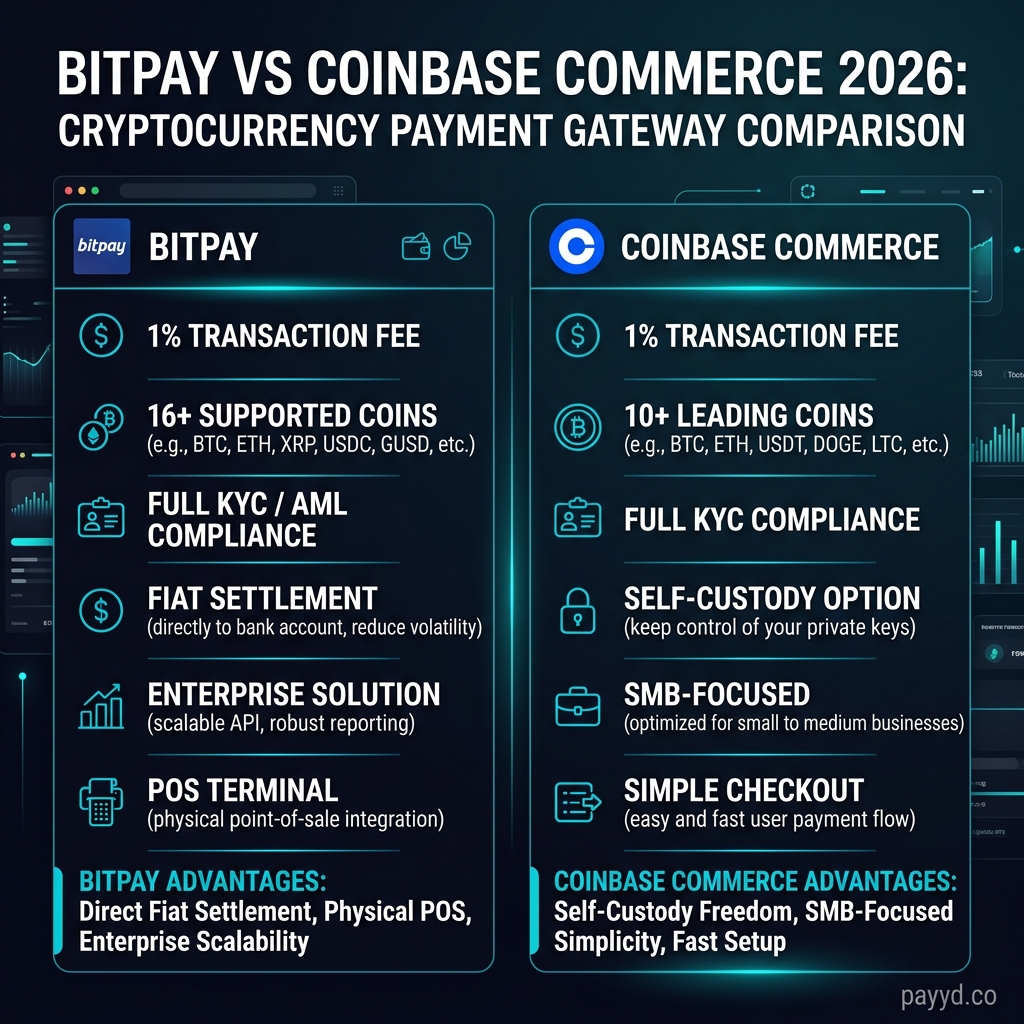
BitPay (founded 2011) is the oldest crypto payment processor. Enterprise-focused with POS terminals, fiat settlement, mass payouts, and Lightning Network support. Think of it as the "Stripe of crypto" — full-featured, established, but expensive and heavy on KYC.
Coinbase Commerce is the payment arm of Coinbase, the largest US crypto exchange. Simpler setup, self-custody option, and the trust of the Coinbase brand. Fewer features than BitPay but easier to get started.
Fees Comparison
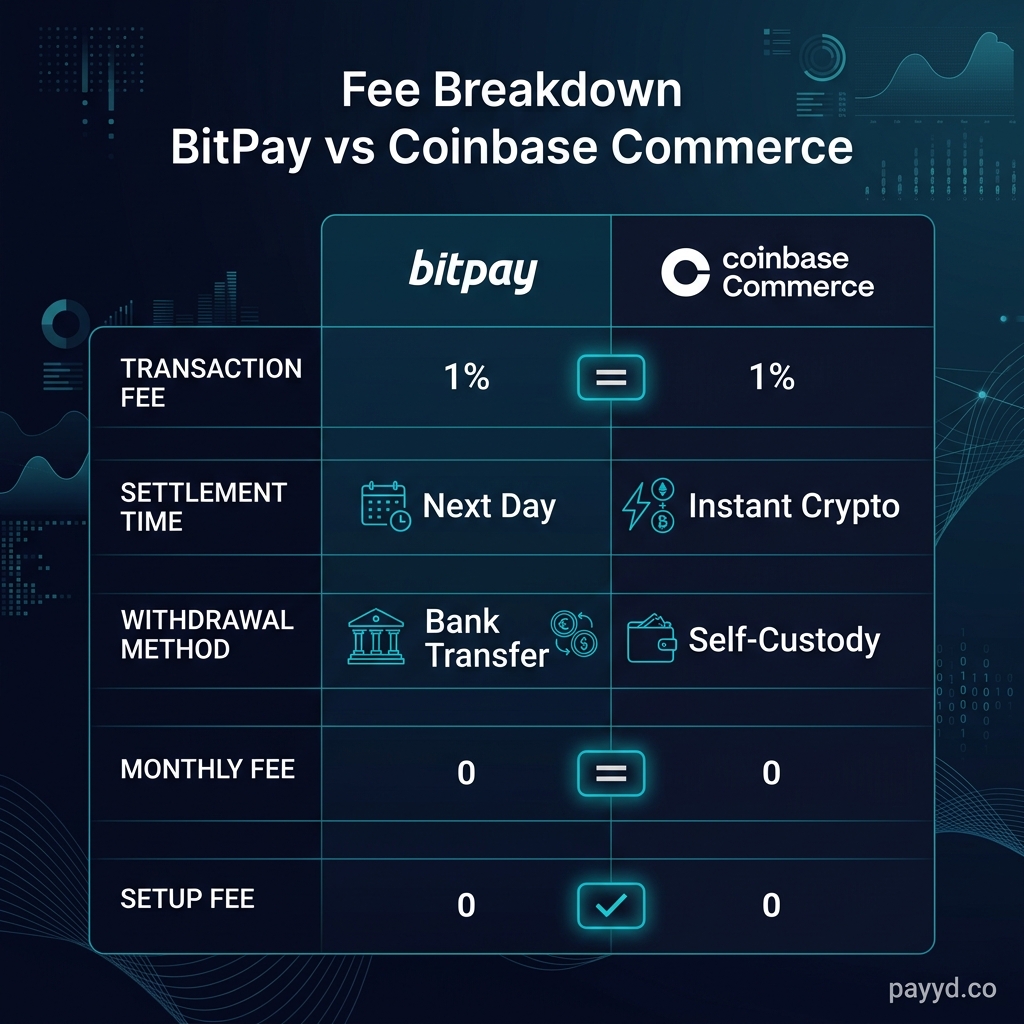
| Fee Type | BitPay | Coinbase Commerce |
|---|---|---|
| Transaction Fee | 1% | 1% |
| Settlement | Next business day (fiat) | Instant (crypto to self-custody) |
| Monthly | $0 | $0 |
| Setup | $0 | $0 |
Identical pricing. The difference is in how you get paid: BitPay settles to your bank in fiat (next business day), while Coinbase Commerce can send crypto directly to your self-custody wallet (instant). If you want dollars in your bank, BitPay is more streamlined. If you want to hold crypto, Coinbase Commerce's self-custody is the advantage.
Feature-by-Feature Comparison
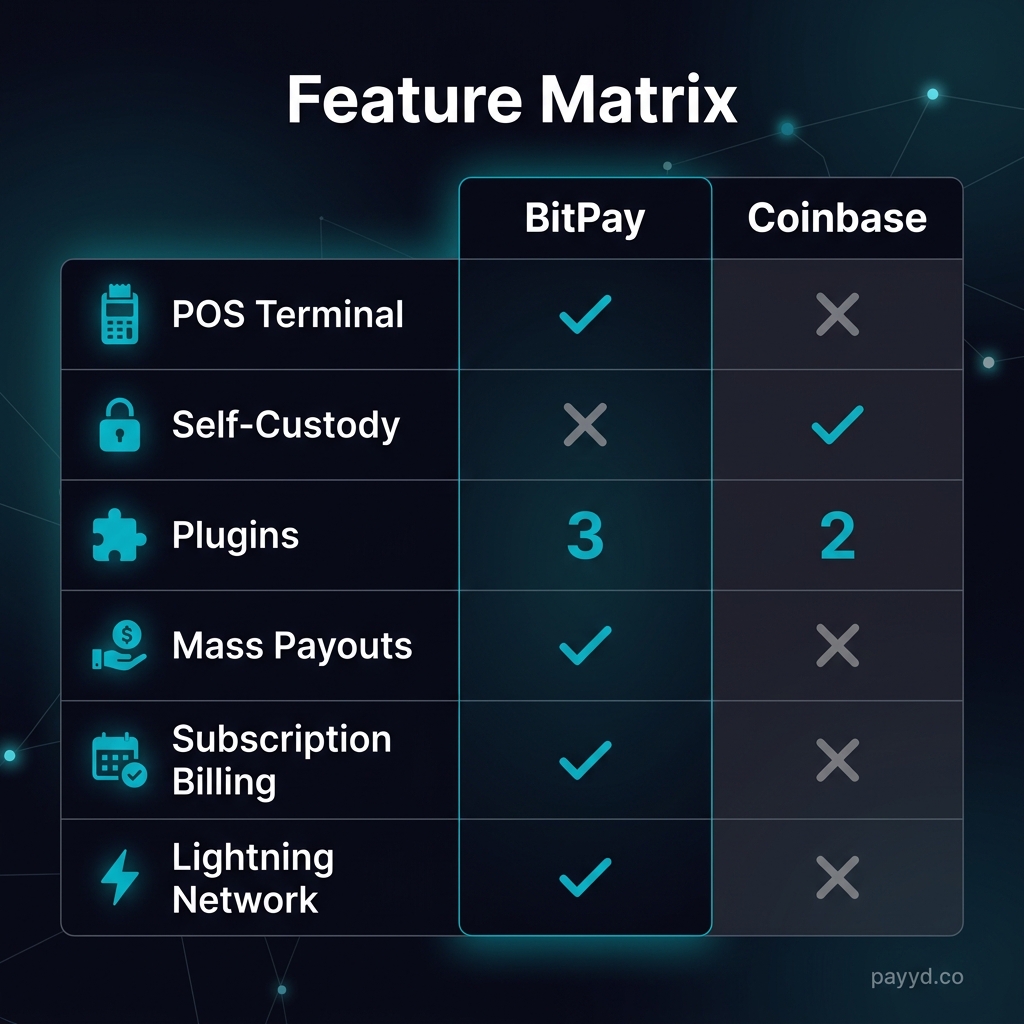
| Feature | BitPay | Coinbase Commerce |
|---|---|---|
| POS Terminal | Yes | No |
| Self-Custody | No | Yes |
| Lightning Network | Yes | No |
| Mass Payouts | Yes | No |
| Subscription Billing | Yes | No |
| Fiat Settlement | Yes | Partial |
| Plugins | 3 | 2 |
| Crypto Debit Card | Yes | No |
BitPay wins 6-1 on features. POS terminal, Lightning Network, mass payouts, subscription billing, fiat settlement, and a crypto debit card — Coinbase Commerce has none of these. The one area Coinbase wins: self-custody.
Custody: The Key Difference
This is the single biggest differentiator. BitPay is fully custodial — they hold your funds until settlement. Coinbase Commerce offers a self-custody option where payments go directly to a wallet you control.
For merchants who care about custody and control, this matters. With BitPay, if the company faces regulatory issues or goes offline, your pending settlement is at risk. With Coinbase Commerce self-custody, your funds are in your wallet the moment the transaction confirms.
That said, if you want true non-custodial without any KYC, neither BitPay nor Coinbase Commerce delivers. Look at BTCPay Server, Coinremitter, or ATLOS instead.
Who Should Use Which?
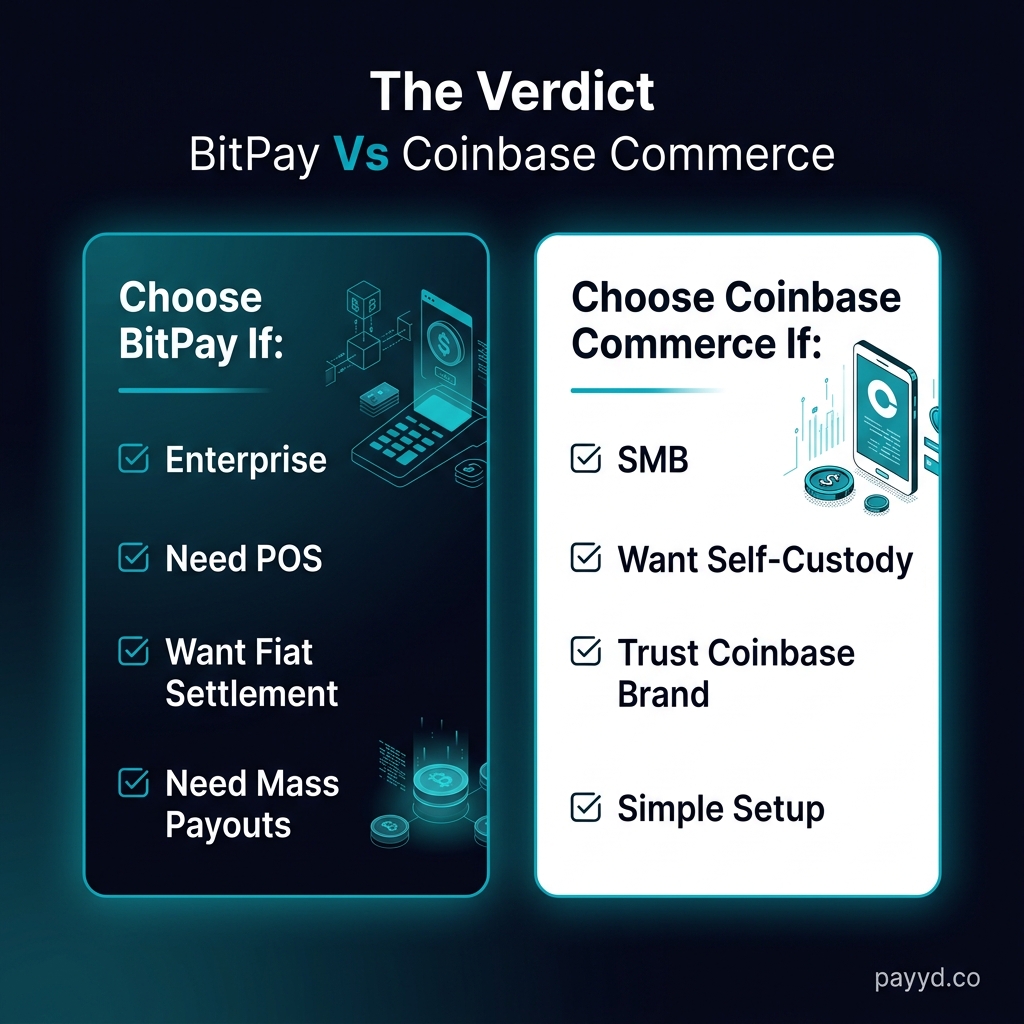
Choose BitPay If:
- You need in-store POS
- You want fiat settlement to bank
- You need mass payouts
- You want subscription billing
- Enterprise with 14+ year track record
Choose Coinbase Commerce If:
- You want self-custody of funds
- You trust the Coinbase brand
- Simple online checkout is enough
- You prefer holding crypto, not fiat
- SMB with basic payment needs
Better Alternatives to Both
Honestly? For most merchants in 2026, both BitPay and Coinbase Commerce are outdated choices. Here's why:
- NOWPayments (0.5%) — half the fee, 300+ coins (vs 16), 7 plugins (vs 3), minimal KYC
- BTCPay Server (0%) — free, non-custodial, no KYC, open source
- BlockBee (0.25%) — quarter the fee, no KYC, 7 plugins, mass payouts
All three are cheaper, support more coins, and require less KYC than either BitPay or Coinbase Commerce. See our complete comparison of all 27 gateways.
FAQ
Which is cheaper, BitPay or Coinbase Commerce?
Both charge 1% per transaction with no monthly fees. They're identical on price. For lower fees, use NOWPayments (0.5%) or BlockBee (0.25%).
Can I use both BitPay and Coinbase Commerce?
Yes — they install as separate payment options. Some merchants offer both to give customers choice. But there's no practical reason to since they charge the same fee and accept similar coins.
Does either work without KYC?
No — both require full identity verification. For no-KYC alternatives, see our no-KYC gateway comparison which lists 16 options.
Which has better Shopify/WooCommerce support?
BitPay has plugins for Shopify, WooCommerce, and Magento. Coinbase Commerce has Shopify and WooCommerce. For maximum plugin support (7 platforms), use BlockBee instead.