Non-Custodial Crypto Wallets — Your Keys, Your Coins (2026 Guide)
Non-custodial wallets give you full control of your crypto. We explain how they work, compare the best options, and show why they matter for payment processing.
Key Takeaways
- Non-custodial wallets let you control your private keys — no exchange or company can freeze your funds
- "Not your keys, not your coins" — $12B+ has been lost to exchange hacks and collapses (FTX, Mt. Gox)
- For merchants: non-custodial payment gateways send payments directly to your wallet
- Best options: MetaMask (multi-chain), Phantom (Solana), Ledger (hardware), Exodus (desktop)
Table of Contents
A non-custodial crypto wallet is one where you — and only you — hold the private keys. No company, exchange, or third party has access to your funds. If the wallet company goes bankrupt tomorrow, your crypto is safe because the keys exist only on your device.
This matters more than most people think. Over $12 billion in user funds have been lost to exchange hacks and collapses — FTX ($8B), Mt. Gox ($470M), Celsius ($4.7B). In every case, users who self-custodied their crypto were unaffected.
What Is a Non-Custodial Wallet?
When you create a non-custodial wallet, it generates a seed phrase — 12 or 24 random words. This seed phrase IS your wallet. Anyone who has it controls all funds. The wallet app is just an interface — you can import the same seed phrase into any compatible wallet and access the same funds.
Compare this to a custodial wallet (Coinbase, Binance): the exchange holds the private keys. You have an account with a balance, like a bank. Convenient, but you're trusting the exchange not to lose, freeze, or mismanage your funds.
Why Non-Custodial Matters
- Immunity from exchange failures — FTX, Celsius, Voyager — none affected self-custody users
- No account freezes — no one can block your transactions or confiscate funds
- Privacy — no KYC required to receive or send crypto
- Sovereignty — you don't need permission to access your own money
- For merchants — non-custodial gateways eliminate the risk of a payment processor holding your revenue
Custodial vs Non-Custodial
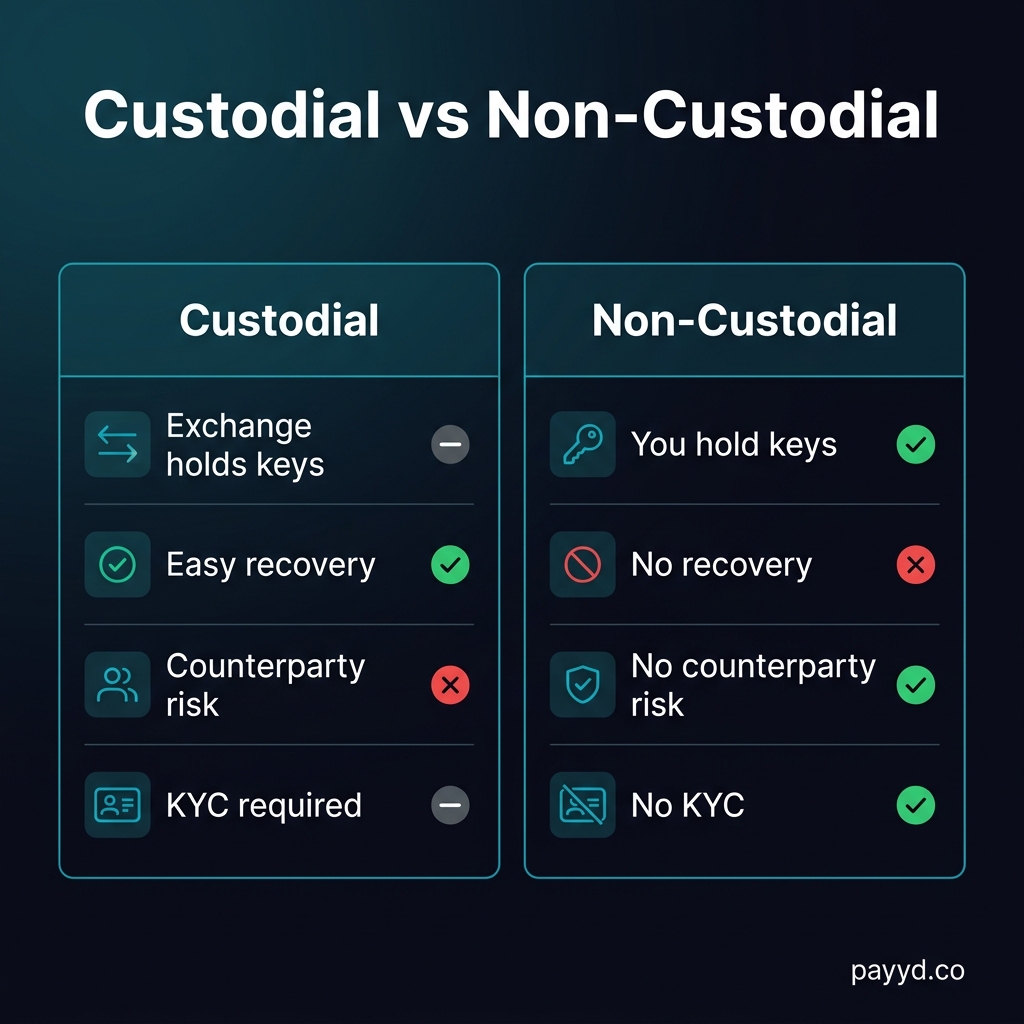
| Aspect | Non-Custodial | Custodial |
|---|---|---|
| Key control | You hold keys | Exchange holds keys |
| Recovery | Seed phrase only | Password reset |
| KYC | None | Required |
| Freeze risk | Zero | Possible |
| Hack risk | Your device only | Exchange-wide |
Best Non-Custodial Wallets 2026
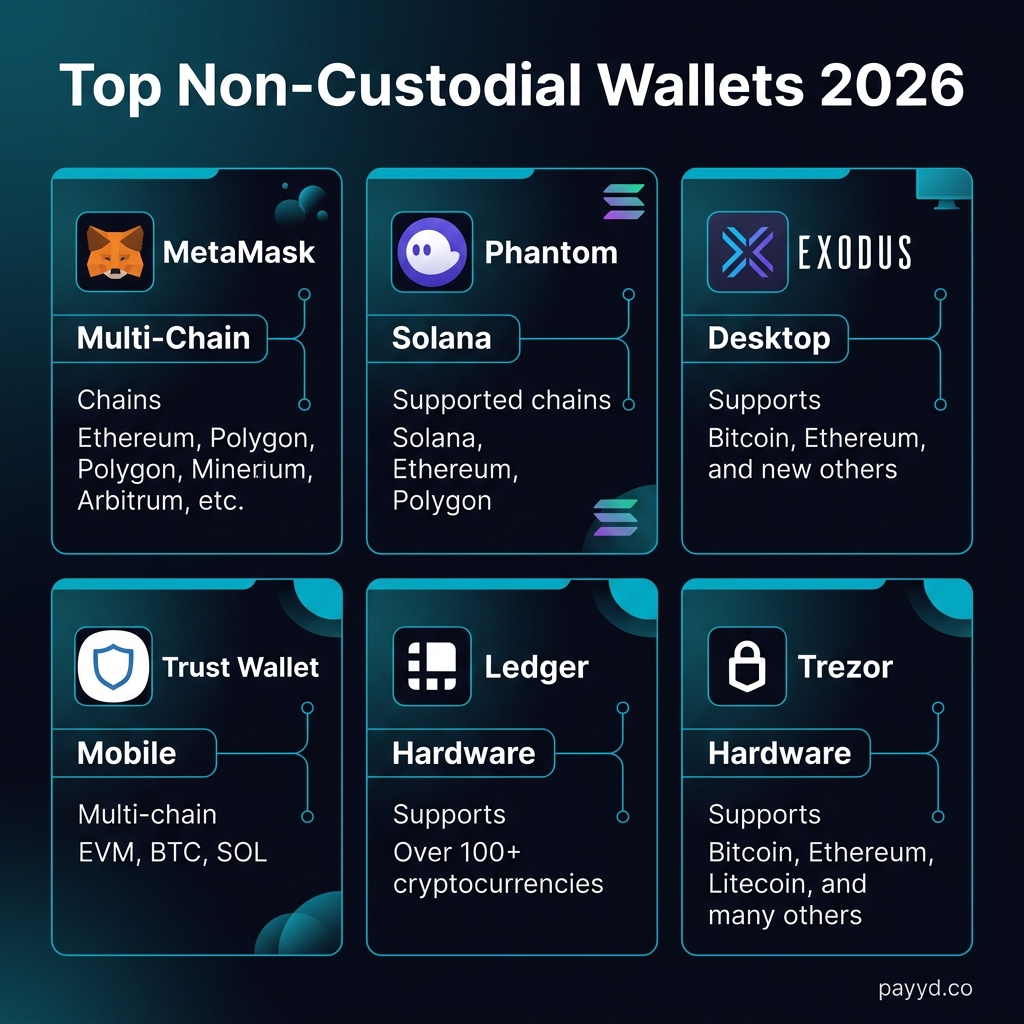
MetaMask
Multi-chain (Ethereum, BSC, Polygon, etc.). Browser extension + mobile. Best for EVM chains and DeFi.
Phantom
Solana + Ethereum + Polygon. Clean UI. Best for Solana Pay integration.
Ledger
Hardware wallet. Keys never leave the device. Best for merchants storing large balances.
Exodus
Desktop + mobile. 250+ assets. Built-in exchange. Best for beginners who want a polished interface.
Trust Wallet
Mobile-first. 70+ chains. Built-in dApp browser. Best for mobile-first users.
Trezor
Hardware wallet. Open source. Best for security maximalists who want auditable firmware.
For Merchants: Non-Custodial Payment Gateways
The same principle applies to payment processing. Non-custodial payment gateways route customer payments directly to your wallet — the gateway never holds your funds. This eliminates the risk of a payment processor going bankrupt with your money.
Non-custodial gateways in our directory:
- BTCPay Server — 0% fee, self-hosted, open source
- Coinremitter — 0.23%, no KYC
- Paymento — 0.5%, BNPL
- ATLOS — 0.4%, 11 chains
- Apirone — 1%, Bitcoin-focused
- NexaPay — 1-3%, card-to-crypto
FAQ
What happens if I lose my seed phrase?
Your funds are permanently lost. There is no recovery mechanism — no company can help you. This is the trade-off for self-custody. Store your seed phrase on metal (not paper) in a secure location. Consider splitting it across multiple locations.
Is a hardware wallet necessary?
For large amounts (>$10,000), yes. Hardware wallets (Ledger, Trezor) keep your private keys on an air-gapped device that never connects directly to the internet. For small amounts, a software wallet (MetaMask, Phantom) is sufficient.