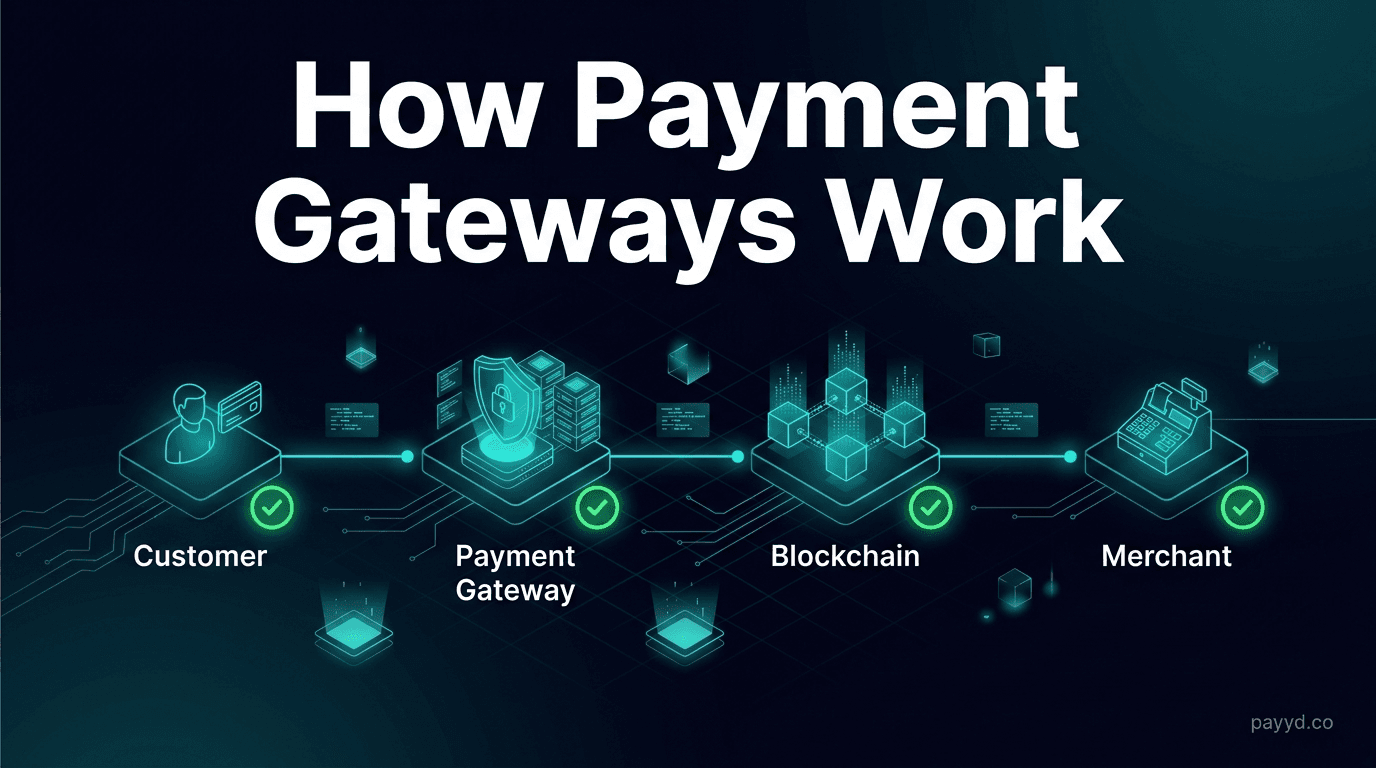
How Do Payment Gateways Work? Traditional vs Crypto Explained
Step-by-step explanation of how payment gateways work. Traditional card flow vs crypto flow, why crypto is simpler and cheaper, with clear diagrams and comparison.
Key Takeaways
- A payment gateway is the technology that captures payment details and initiates the transaction — whether card or crypto
- Traditional card payments pass through 6 intermediaries (gateway, processor, card network, issuing bank, acquiring bank, merchant bank) — crypto uses 1-2
- Crypto payment gateways are fundamentally simpler: customer wallet → gateway → blockchain → merchant wallet. No banks required
- This simplicity is why crypto gateways charge 0-1% while card processors charge 2.5-3.5%
A payment gateway is the technology that makes it possible to accept payments online. Whether a customer is entering their credit card number or scanning a Bitcoin QR code, there is a payment gateway working behind the scenes to make that transaction happen.
But how a gateway works depends entirely on whether it is processing traditional card payments or crypto payments — and the difference is dramatic. I am going to walk you through both flows step by step so you can see exactly why crypto payments are faster, cheaper, and simpler.
What Is a Payment Gateway?
A payment gateway is the bridge between a customer who wants to pay and a merchant who wants to get paid. Its core job is to:
- Present a payment interface — a checkout form, payment button, QR code, or invoice
- Capture payment information — securely collect what is needed to process the transaction
- Initiate the transaction — send the payment data to the network that will move the money
- Return the result — tell both the merchant and customer whether the payment succeeded or failed
That is it at the highest level. The complexity lies in what happens between steps 2 and 4 — and that is where traditional and crypto gateways diverge completely.
How Traditional Card Payment Gateways Work
When a customer enters their credit card number on your website and clicks "Pay," here is what happens in the next 2-3 seconds:
Step 1: Data Capture (The Gateway)
The payment gateway (Stripe, Square, PayPal) encrypts the card number, expiration date, and CVV. This encrypted data is called a "token." The gateway sends this token to the payment processor.
Step 2: Authorization Request (The Processor)
The payment processor (which may be the same company as the gateway, or separate) routes the transaction to the appropriate card network — Visa, Mastercard, or Amex.
Step 3: Card Network Routing
The card network (Visa/Mastercard) receives the transaction and forwards it to the customer's bank — the issuing bank that gave them the card.
Step 4: Bank Authorization
The issuing bank checks: Does the card have enough available credit? Is the card reported stolen? Does the transaction look fraudulent? If everything passes, the bank sends an approval code back through the chain.
Step 5: Response Cascade
The approval travels back: issuing bank → card network → processor → gateway → your website. The customer sees "Payment Successful."
Step 6: Settlement (1-3 Days Later)
The actual money does not move during authorization. Settlement happens 1-3 business days later in a batch process. The issuing bank sends funds through the card network to the acquiring bank (your merchant bank), which deposits the money into your account — minus fees from each intermediary.
Total intermediaries involved: 6 (gateway, processor, card network, issuing bank, acquiring bank, merchant bank)
How Crypto Payment Gateways Work
Now watch the same transaction in crypto:
Step 1: Invoice Creation (The Gateway)
The crypto payment gateway (NOWPayments, BTCPay Server, etc.) generates a unique payment address or QR code. This address is specific to this transaction so the gateway can match the incoming payment to your order.
Step 2: Customer Sends Payment
The customer scans the QR code or copies the address and sends crypto from their wallet. The transaction is broadcast to the blockchain network.
Step 3: Blockchain Confirmation
The blockchain network (Bitcoin, Ethereum, Tron, etc.) validates the transaction through its consensus mechanism. This takes seconds to minutes depending on the network. No bank is involved. No card network. No intermediary.
Step 4: Gateway Detection and Notification
The gateway monitors the blockchain, detects the confirmed transaction, and notifies your system (via webhook, callback, or API). The payment is complete.
Step 5: Funds Available
For non-custodial gateways, funds are already in your wallet — they went directly to your address in Step 2. For custodial gateways, funds are available for withdrawal immediately or within hours.
Total intermediaries involved: 1-2 (gateway + blockchain)
Side-by-Side Comparison
Why Crypto Is Simpler and Cheaper
The cost difference between traditional and crypto payment processing comes down to one thing: intermediaries. Each entity in the traditional payment chain takes a cut:
- Interchange fee (paid to issuing bank): 1.5-2.5%
- Assessment fee (paid to card network): 0.13-0.15%
- Processor markup: 0.2-0.5%
- Gateway fee: $0.10-0.30 per transaction
In crypto, there is one gateway fee (0-1%) and a blockchain network fee (usually pennies). That is it. The blockchain replaces the card network, the issuing bank, the acquiring bank, and the settlement system — all with a single decentralized protocol.
For a detailed fee comparison between different crypto gateways, see our payment gateway vs payment processor breakdown.
Types of Crypto Payment Gateways
Not all crypto gateways work the same way. Here are the main categories:
Hosted Custodial Gateways
The gateway hosts everything and holds your funds temporarily. Easiest to set up. Examples: NOWPayments, Plisio, BitPay
Hosted Non-Custodial Gateways
The gateway hosts the payment interface but funds go directly to your wallet. No holding period. Examples: Coinremitter, ATLOS, PayGate.to
Self-Hosted Gateways
You run the gateway on your own server. Maximum control, zero fees, but requires technical setup. Example: BTCPay Server
Smart Contract Gateways
Payments are processed entirely through blockchain smart contracts. No server at all — just code on-chain. Example: ATLOS (hybrid model)
How to Choose a Payment Gateway
Whether traditional or crypto, choosing a gateway comes down to your priorities:
- Lowest cost? BTCPay Server (0%) or Coinremitter (0.23%)
- Easiest setup? NOWPayments — sign up, get API key, integrate in an hour
- Need fiat settlement? BitPay or CoinGate — they convert crypto to USD for you
- Maximum privacy? PayGate.to — no registration, no KYC, no account needed
- Both crypto AND cards? Use a crypto gateway alongside your existing Stripe or Square setup
For the full comparison of all crypto payment gateways available in 2026, see our complete gateway comparison.
Simpler Payments Start Here
Crypto gateways cut out the middlemen. Fewer steps, lower fees, faster settlement.
Compare Payment Gateways →Frequently Asked Questions
Can I use a crypto payment gateway without any coding?
Yes. Most crypto gateways offer no-code integrations: payment buttons, hosted checkout pages, and e-commerce plugins (WooCommerce, Shopify). NOWPayments, CoinGate, and Plisio all have WordPress/WooCommerce plugins that require zero coding.
Do I need a merchant account to use a crypto payment gateway?
No. Traditional card processing requires a merchant account at a bank. Crypto gateways only need your wallet address. Some custodial gateways require an account on their platform, but that takes minutes — not the days-to-weeks of traditional merchant account applications.
How fast does a crypto payment gateway process transactions?
It depends on the blockchain. Bitcoin: 10-60 minutes for full confirmation (some gateways accept after 1 confirmation ~10 min). Ethereum: 12 seconds to a few minutes. Lightning Network: instant (seconds). Tron/Polygon: 2-3 seconds. Most gateways notify you within a minute.
What happens if a customer sends the wrong amount?
Most crypto gateways handle underpayments and overpayments automatically. For small discrepancies, the gateway may accept the payment. For larger differences, the gateway typically refunds the overpayment or marks the invoice as partially paid so the customer can send the remainder.
Can a crypto payment gateway be used for in-store POS?
Yes. BTCPay Server has a built-in POS terminal. BitPay offers a mobile POS app. NOWPayments has a POS integration. The customer scans a QR code on your device or counter display — same process as online, just in person.
Is it possible to accept both crypto and card payments through one gateway?
Some gateways like CoinGate and BitPay are building hybrid solutions. But in most cases, you will use a crypto gateway alongside your existing card processor. They run independently — add a "Pay with Crypto" option next to your existing card checkout.