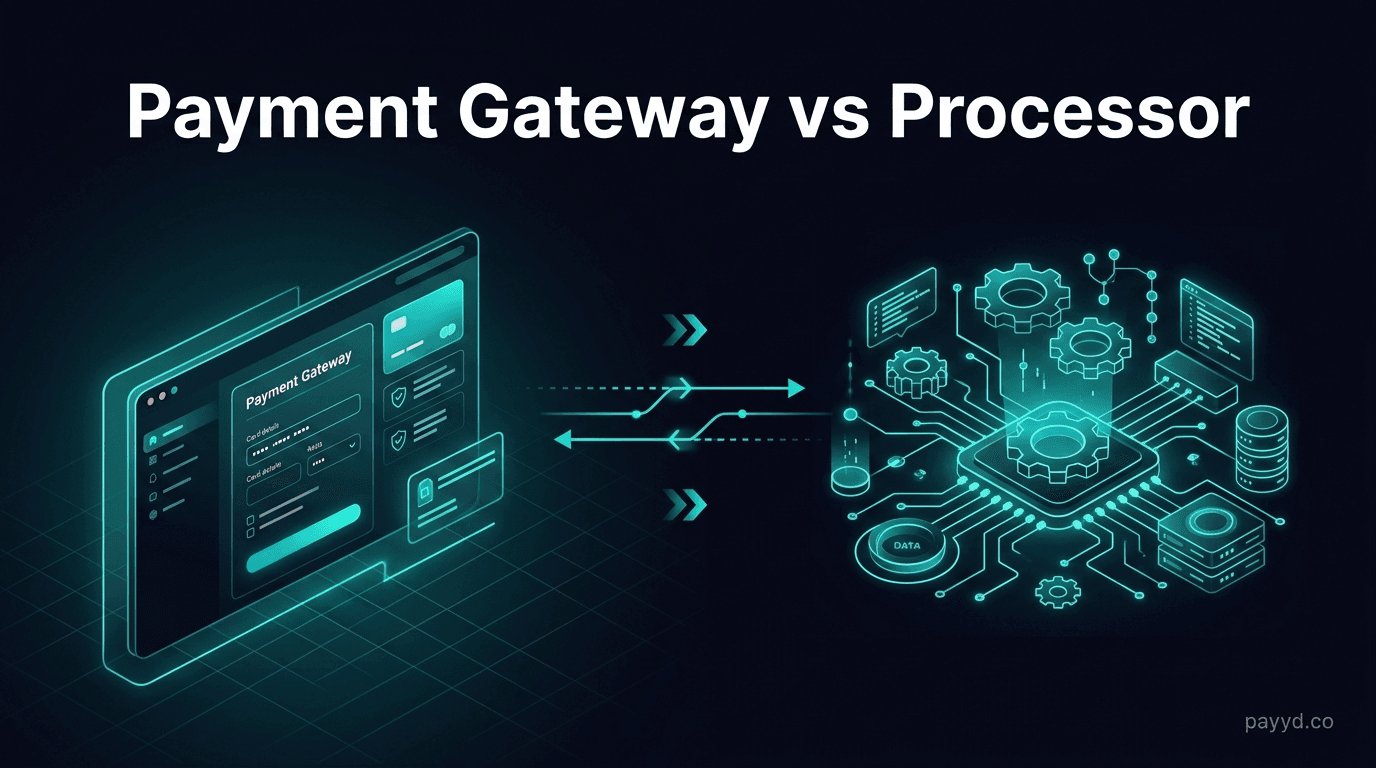
Payment Gateway vs Payment Processor: What's the Difference?
Understand the difference between a payment gateway and a payment processor. How crypto changes the model, side-by-side comparison, and which you actually need for your business.
Key Takeaways
- A payment gateway is the customer-facing interface that captures payment details. A payment processor is the backend engine that moves money between banks
- In traditional payments you need both — in crypto, most gateways act as both gateway AND processor in a single service
- Crypto simplifies the chain: customer wallet → gateway → merchant wallet. No acquiring bank, no card network, no issuing bank
- Understanding this distinction helps you avoid paying for overlapping services and choose the right crypto gateway
If you have ever searched for a way to accept payments online, you have probably seen "payment gateway" and "payment processor" used interchangeably. They are not the same thing — but the confusion is understandable because in crypto, the line between them has almost disappeared.
I am going to break this down in plain language so you understand exactly what each one does, where they overlap, and why it matters for choosing the right solution for your business.
What Is a Payment Gateway?
A payment gateway is the customer-facing layer of a transaction. It is the interface — the checkout page, the card entry form, the QR code your customer scans. Its job is to securely capture payment information and pass it along for processing.
Think of it as the front door. When a customer enters their credit card number on your checkout page, the payment gateway encrypts that data and sends it to the payment processor. The gateway never moves money itself — it just handles the handoff.
Traditional gateway examples: Stripe (checkout), Square (POS terminal), PayPal checkout button.
What a gateway does:
- Displays the payment form or checkout interface
- Encrypts and tokenizes payment data
- Sends transaction details to the processor
- Returns approval or decline to the customer
- Handles 3D Secure / fraud screening at checkout
What Is a Payment Processor?
A payment processor is the backend engine that actually moves money. Once the gateway captures payment details, the processor takes over — routing the transaction through card networks, communicating with the customer's bank (issuing bank), and settling funds into your bank account (acquiring bank).
The processor handles authorization, settlement, and clearing. You never see it, your customer never sees it, but without it, no money moves.
Traditional processor examples: Worldpay, First Data (Fiserv), Chase Paymentech, Adyen (backend).
What a processor does:
- Routes transaction data through card networks (Visa, Mastercard)
- Communicates with issuing and acquiring banks
- Handles authorization (approve/decline)
- Manages settlement (moving funds to the merchant)
- Processes chargebacks and disputes
Key Differences: Gateway vs Processor
The core distinction is simple: the gateway collects, the processor moves. One faces the customer, the other faces the financial network.
How Traditional Payments Flow
In a standard credit card transaction, the full chain looks like this:
- Customer enters card details on your checkout page (the gateway)
- Gateway encrypts the data and sends it to the processor
- Processor routes the request through the card network (Visa/Mastercard)
- Card network sends it to the customer's issuing bank
- Issuing bank approves or declines
- Response travels back through the chain: issuing bank → card network → processor → gateway → customer
- Settlement happens 1-3 business days later — funds move from issuing bank to your acquiring bank
That is six intermediaries touching every single transaction. Each one takes a cut. Each one adds latency. Each one can decline or freeze your funds.
How Crypto Changes Everything
This is where it gets interesting for merchants. In crypto payments, the traditional split between gateway and processor mostly disappears.
The crypto payment flow:
- Customer scans a QR code or clicks a payment link (the gateway)
- Gateway generates a unique wallet address and monitors the blockchain
- Customer's wallet sends crypto directly on-chain
- Blockchain confirms the transaction (minutes, not days)
- Gateway detects confirmation and notifies your system
- Funds arrive in your merchant wallet — done
No card network. No issuing bank. No acquiring bank. No processor as a separate entity. The crypto payment gateway handles both the interface AND the transaction monitoring. Services like NOWPayments, Coinremitter, and BTCPay Server are all-in-one — they are the gateway, the processor, and the settlement layer rolled into one.
This is why crypto gateways can charge 0-1% fees while traditional payment processing costs 2.5-3.5%. There are simply fewer middlemen to pay.
Side-by-Side: Traditional vs Crypto Payment Flow
Which Do You Actually Need?
If you are accepting traditional card payments, you need both a gateway and a processor. Companies like Stripe and Square bundle them together, which is why the distinction feels blurry — but under the hood, both functions are running.
If you are accepting crypto payments, you just need a crypto payment gateway. It handles everything. Here is how I would decide:
- Want the simplest setup? NOWPayments — gateway + processor + 300 coins in one integration
- Want zero fees? BTCPay Server — self-hosted, you ARE the gateway and processor
- Want both crypto and fiat? Use a crypto gateway alongside your existing card processor. They do not conflict
- Want fiat settlement from crypto? BitPay or CoinGate — they add crypto-to-fiat conversion on top of the gateway
The bottom line: crypto collapses the traditional payment stack. Instead of paying separately for a gateway, processor, card network access, and bank settlement, you pay one crypto gateway one fee, and the blockchain handles the rest.
For a full comparison of every crypto payment gateway available in 2026, see our complete gateway comparison.
Skip the Middlemen
Crypto payment gateways combine gateway and processor into one — with fees 70% lower than traditional payments.
Compare Crypto Gateways →Frequently Asked Questions
Is Stripe a payment gateway or a payment processor?
Stripe is both. It provides the customer-facing checkout (gateway) and handles backend authorization and settlement (processor). Most modern payment companies bundle both functions — which is exactly what crypto gateways do as well.
Can I use a payment gateway without a payment processor?
Not for traditional card payments — you need both. But in crypto, a single gateway like NOWPayments or BTCPay Server handles everything, so there is no separate processor to worry about.
Why are crypto payment fees so much lower than card fees?
Traditional card payments involve 5-6 intermediaries, each taking a cut. Crypto payments use the blockchain as the settlement layer, eliminating card networks, issuing banks, and acquiring banks. Fewer middlemen means lower fees.
Do I need a merchant account with a bank to accept crypto?
No. Crypto payments settle directly to your wallet — no bank account required. If you want fiat settlement (crypto converted to USD), you will need a gateway like BitPay or CoinGate that offers that service, and they may require a linked bank account.
What is the difference between a payment gateway and a payment service provider?
A payment service provider (PSP) is a company that bundles gateway, processor, and merchant account into one service. Stripe, PayPal, and Square are PSPs. In crypto, most gateways are effectively PSPs because they handle the entire payment flow.
Can I use a crypto gateway alongside my existing card processor?
Absolutely. Most merchants add crypto as an additional payment option alongside Stripe or Square. Crypto gateways operate independently — they do not interfere with your existing card processing. You simply add a "Pay with Crypto" button to your checkout.