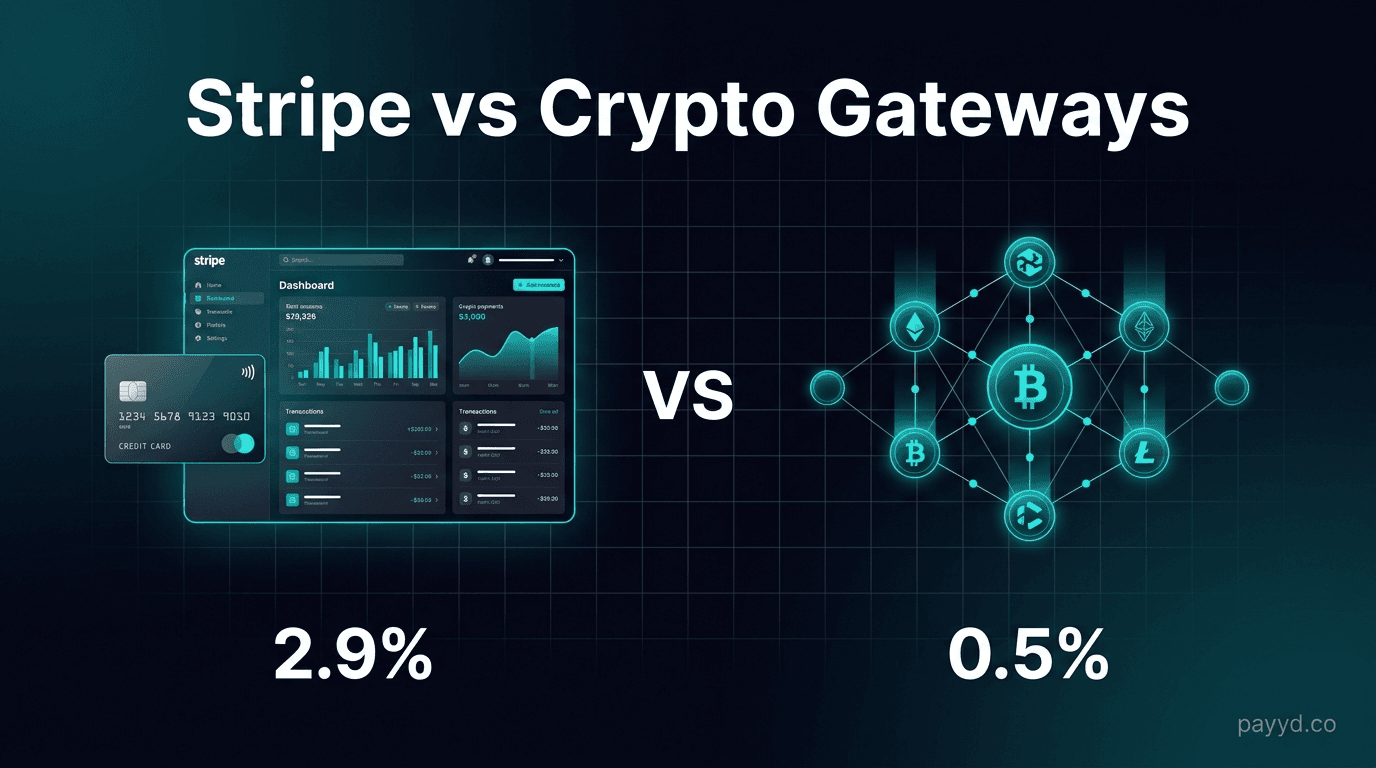
Stripe vs Crypto Payment Gateways: Which Should Your Business Use?
Stripe charges 2.9% + $0.30. Crypto gateways charge 0-1%. We break down when Stripe makes sense, when crypto wins, and how to use both.
Key Takeaways
- Stripe charges 2.9% + $0.30 per transaction. The best crypto gateways charge 0-0.5% with no per-transaction flat fee
- On $10,000/month in sales, switching from Stripe to NOWPayments saves you $240/month ($2,880/year)
- Stripe wins on chargebacks, customer trust, and subscription management. Crypto wins on fees, global reach, and settlement speed
- The smart move for most businesses: use both. Stripe for credit cards, a crypto gateway for crypto payments. Let customers choose
Every online business uses Stripe. It is the default choice, and for good reason — the developer experience is excellent, the checkout flow converts well, and it just works. But "just works" comes at a cost: 2.9% + $0.30 per transaction in the US, higher internationally.
Crypto payment gateways charge between 0% (BTCPay Server) and 1% (BitPay, CoinGate) with no per-transaction flat fee. On a $100 sale, Stripe takes $3.20. NOWPayments takes $0.50. That $2.70 difference adds up fast.
But raw fees are not the whole story. I have used both Stripe and multiple crypto gateways for real businesses, and the comparison is more nuanced than the crypto evangelists would have you believe. Let me break it down honestly.
How Stripe Works (Quick Refresher)
Stripe processes credit and debit card payments. Your customer enters their card details, Stripe handles the authorization, fraud detection, and settlement. You receive funds in your bank account, typically 2 business days later (or instantly for an extra 1% fee).
Key facts:
- Fee: 2.9% + $0.30 per successful transaction (US domestic cards)
- International cards: +1.5% cross-border fee
- Currency conversion: +1% if applicable
- Chargebacks: $15 fee per dispute (refunded if you win)
- Payout schedule: 2 business days standard, instant available
- Setup: Identity verification required, business verification for some industries
How Crypto Payment Gateways Work
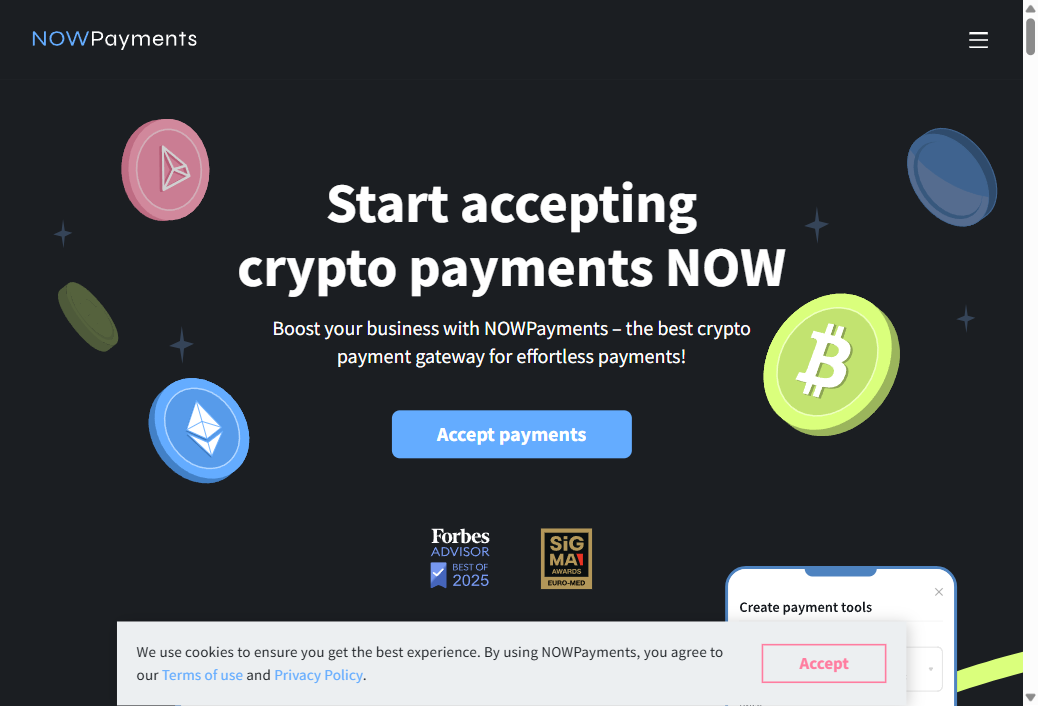
A crypto gateway generates a payment address or invoice when your customer checks out. The customer sends crypto from their wallet, the gateway confirms the payment, and you receive either crypto in your wallet or fiat in your bank account (depending on the gateway).
Key facts for the leading gateways:
- Fee: 0% (BTCPay Server) to 1% (BitPay, CoinGate) — most charge 0.5%
- No per-transaction flat fee — huge advantage for small transactions
- No cross-border fees — crypto is borderless by default
- No chargebacks — crypto transactions are irreversible
- Settlement: Crypto settles in minutes, fiat settlement varies (1-3 business days with BitPay)
- Setup: Ranges from zero KYC to full identity verification
Side-by-Side Comparison
Fee Breakdown: Real Numbers
Let me show you what these fee differences look like with real revenue numbers.
Stripe fees assume $50 average transaction size (so $0.30 flat fee = 0.6% additional). Actual savings depend on your average order value.
The $0.30 per-transaction flat fee is what kills Stripe for small transactions. A $5 purchase costs you $0.45 in Stripe fees — that is 9%. The same $5 sale on NOWPayments costs $0.025 — literally 0.5%. For micro-transactions and digital goods, the difference is enormous.
When Stripe Is the Better Choice
I am not going to pretend crypto gateways are always better. Stripe wins in several important scenarios:
- Your customers do not hold crypto. This is the most obvious one. If your audience is mainstream consumers, most of them will want to pay with a credit card. Offering only crypto would tank your conversion rate
- You need chargebacks as a trust signal. Ironically, chargeback protection benefits consumers. Some customers will not buy from a business that does not accept credit cards because they want the safety net of disputing a charge
- Subscription billing is your core model. Stripe Billing is years ahead of any crypto subscription solution. Automatic retries, proration, usage-based billing, revenue recognition — BoomFi and NOWPayments cannot match this yet
- You are in a regulated industry. Stripe's compliance infrastructure handles PCI DSS, SCA (Strong Customer Authentication in Europe), and regional payment regulations. Running a crypto gateway alongside does not remove your need for compliant card processing
- You need instant fiat settlement. Stripe Instant Payouts put money in your bank account in minutes. Crypto-to-fiat settlement through BitPay or CoinGate takes 1-3 business days
When Crypto Gateways Win
Crypto gateways have clear advantages in these scenarios:
- International sales without borders. Stripe is available in 47 countries and charges extra for cross-border transactions. A crypto gateway works for any customer anywhere on earth with no additional fees. If you sell digital products globally, this matters
- High-risk industries. Stripe famously freezes accounts and holds funds for businesses it considers risky (supplements, CBD, gambling, adult content, certain SaaS categories). Non-custodial crypto gateways cannot freeze your money because they never hold it
- Chargeback-heavy businesses. If you sell digital goods and get hit with "I did not authorize this" chargebacks, crypto eliminates the problem entirely. No chargebacks, ever
- Privacy-focused products. If your customers value privacy (VPN services, privacy tools, political donations), crypto lets them pay without exposing financial information to Stripe, their bank, or anyone else
- Micro-transactions. Anything under $10 gets destroyed by Stripe's $0.30 flat fee. Crypto gateways with percentage-only fees (and especially Lightning payments) make small transactions viable
- You want your money faster. Crypto settles to your wallet in minutes. No 2-day hold, no rolling reserves, no account freezes
The Hybrid Approach: Using Both
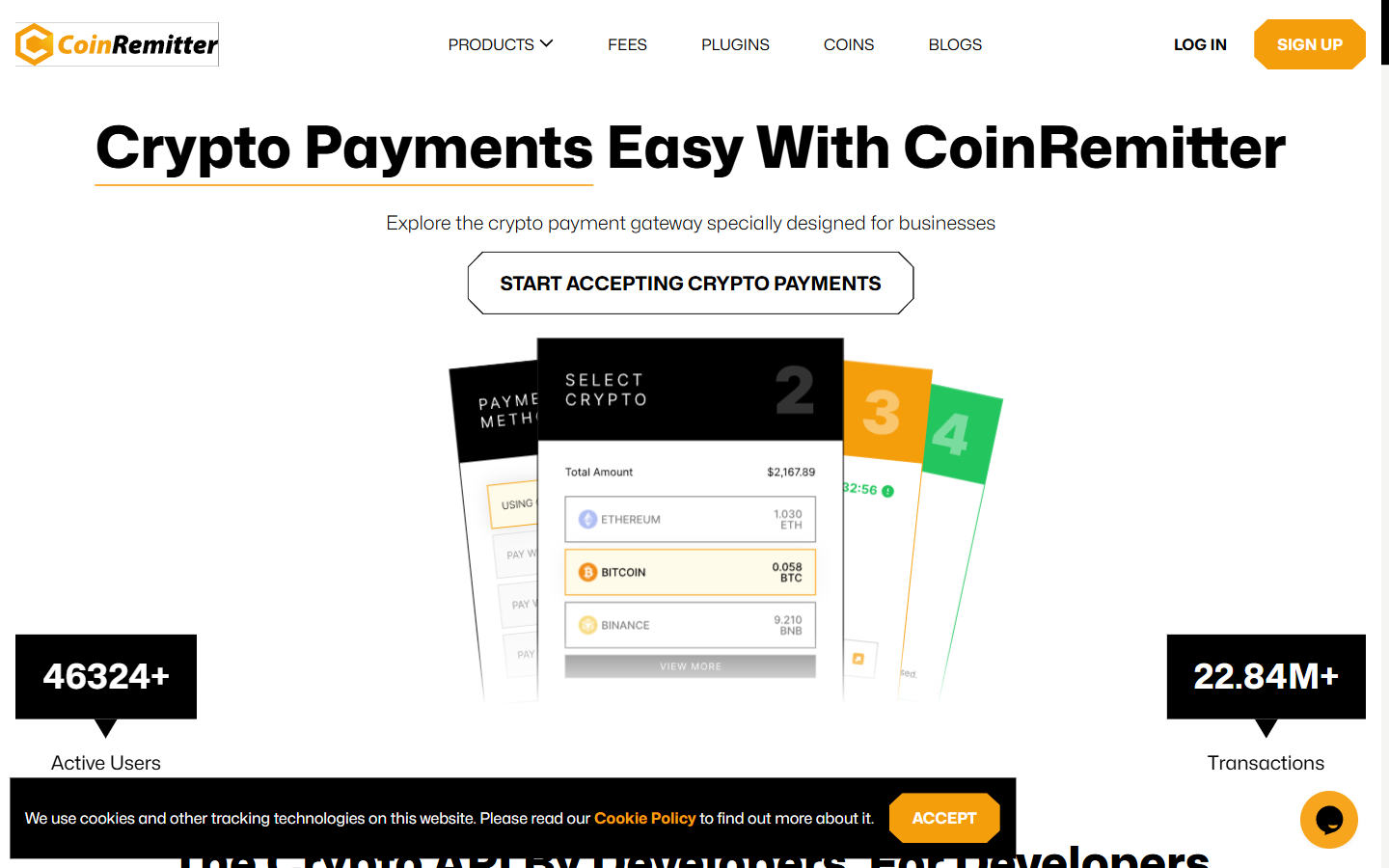
Here is what I actually recommend for most businesses: use Stripe for credit card payments and add a crypto gateway alongside it. Let customers choose how they want to pay.
How to Implement a Hybrid Setup
- Keep Stripe as your primary gateway. Most customers will pay with credit cards. Do not remove that option
- Add NOWPayments or CoinGate as your crypto option. Both offer plugins for WooCommerce, Shopify, and other platforms. The integration adds a "Pay with Crypto" button at checkout. See our fee comparison to pick the right one
- Offer a crypto discount. Since your processing fees are lower on crypto payments, pass some savings to the customer. A 2-3% discount for paying with crypto incentivizes adoption and saves you money even after the discount
- Track payment method analytics. Monitor what percentage of customers choose crypto. This data helps you optimize the checkout flow and decide how much to invest in crypto payment infrastructure
Real-World Example
Say you run a SaaS product at $49/month with 200 subscribers. With Stripe, you pay ~$720/month in fees. If 20% of subscribers switch to crypto (at 0.5% fees), your blended monthly fee drops to ~$590 — saving $1,560/year. And that is with only 20% adoption.
The key insight is that you are not choosing between Stripe and crypto. You are choosing whether to offer crypto as an additional payment method. The cost of adding it is near zero (most gateways have free plans), and the upside includes lower fees, global reach, and a payment option that a growing segment of customers specifically seeks out.
Stop Overpaying on Transaction Fees
Compare fees across every major crypto gateway and find the right complement to your Stripe setup.
Compare Crypto GatewaysFrequently Asked Questions
Does Stripe accept crypto payments?
Stripe discontinued its direct Bitcoin payment support in 2018. As of 2026, Stripe does not natively process crypto payments. They offer USDC payouts through Stripe Connect for platforms, but this is not the same as accepting crypto from customers. To accept crypto, you need a dedicated crypto gateway alongside Stripe.
Can I use Stripe and a crypto gateway at the same time?
Yes, and this is what we recommend. Most e-commerce platforms (WooCommerce, Shopify, custom builds) support multiple payment gateways. Customers see both options at checkout and choose their preferred method.
Is crypto cheaper than Stripe for all transaction sizes?
For transactions over ~$5, crypto gateways are almost always cheaper. For very small transactions (under $1), on-chain crypto fees (gas fees, network fees) might exceed the transaction value. Lightning Network payments remain cheap at any size. Stripe's $0.30 flat fee makes it expensive for micro-transactions.
What about Stripe's new crypto features?
Stripe has been slowly adding crypto-adjacent features like USDC payouts and fiat-to-crypto on-ramps for platforms. These are useful for specific use cases (paying contractors in USDC, letting users buy crypto in your app) but they are not a replacement for a crypto payment gateway. You still cannot accept BTC or ETH as payment through Stripe.
Do crypto gateways handle taxes and reporting like Stripe?
Stripe provides 1099 forms, revenue reporting, and integrates with accounting software. Most crypto gateways offer transaction export (CSV) but limited tax reporting. BitPay is the exception — they provide tax-friendly reporting similar to traditional processors. For other gateways, use a crypto tax tool like Koinly or CoinTracker.
What about Square and PayPal for crypto?
Square (now Block) lets customers buy and sell Bitcoin through Cash App, but merchant crypto payment acceptance is limited. PayPal allows US customers to pay with crypto at checkout, but merchants receive fiat — and PayPal's fees are higher than dedicated crypto gateways. Neither is a competitive alternative to a purpose-built crypto gateway.
How do refunds work with crypto vs Stripe?
Stripe refunds are automatic — the money goes back to the customer's card. Crypto refunds are manual — you send crypto back to the customer's wallet address. This is more work, but some businesses see it as an advantage because customers cannot initiate chargebacks. You control the refund process entirely.
Will adding crypto payments confuse my customers?
Not if you implement it properly. The crypto payment option appears as an additional button alongside the credit card form. Customers who do not hold crypto simply ignore it and pay with their card as usual. Customers who prefer crypto appreciate having the option.